Óbidos
A walled medieval town inland from the Silver Coast, lived in by few and visited by many.
Updated 14 September 2026
The short version
- A walled medieval town on the Silver Coast, 85 km north of Lisbon, with a lagoon and beaches ten minutes away, the A8 into the capital in about an hour, and the airport about an hour and a quarter.
- Suits people who want quiet, a garden and the sea within reach at Silver Coast prices, and golfers. Does not suit anyone who needs a town with life after dark: the walled town is for visitors, and residents live around it.
- Asking prices around €2.800 per square metre; a two-bedroom flat rents for about €900 a month, a house for about €1.500.
- Óbidos council: IMI 0,36%, tourist tax €1,50 a night for up to five nights, no limits on new short-let registrations.
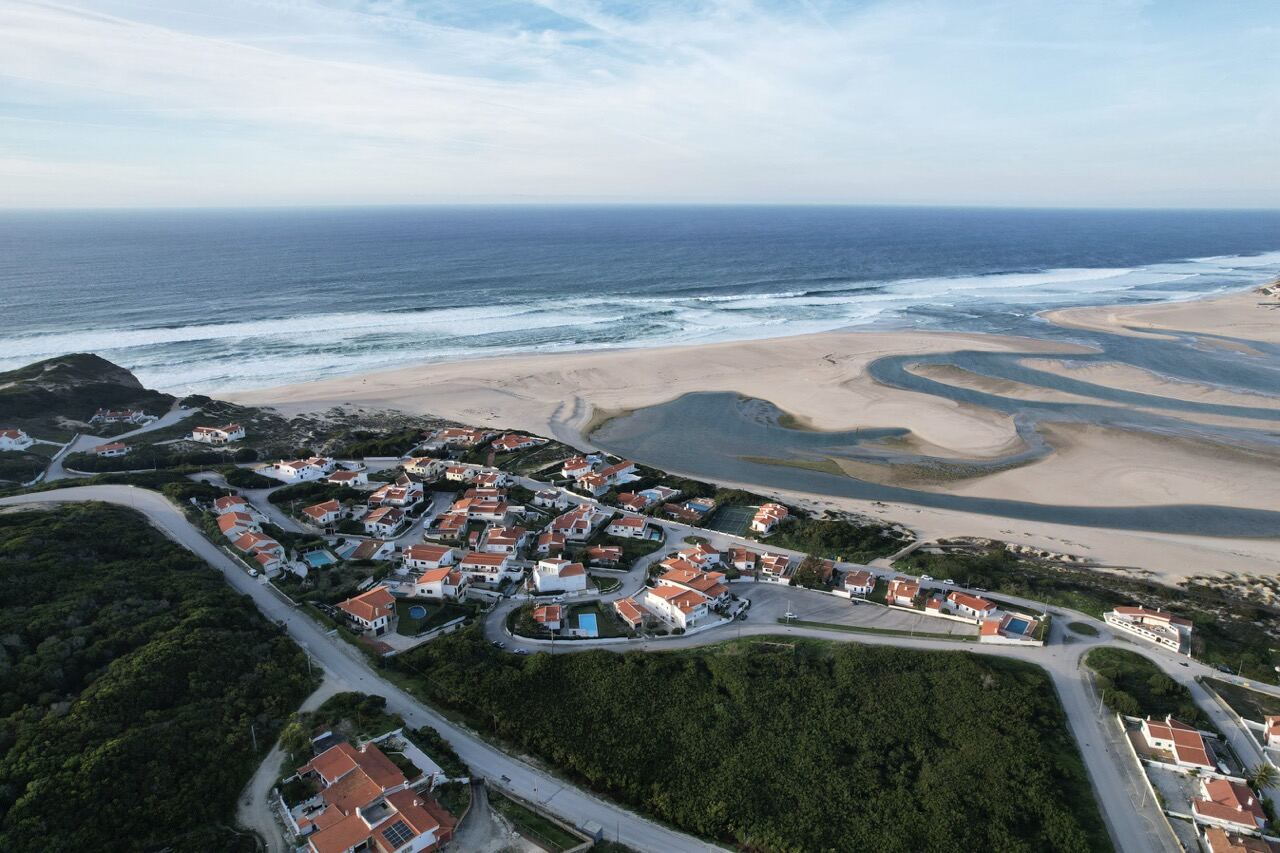
- The one thing everybody says: the lagoon. The shallow water between the town and the sea is where children learn to sail and kitesurfers learn to fly.
The town
What it is like to live there
The walled town is one of Portugal's postcards: a castle, whitewashed lanes, bougainvillea, a chocolate festival in spring and a Christmas village in winter, and coaches from Lisbon every day of the year. Almost nobody lives inside the walls. The municipality's 12.000 people live in the villages around it, on the lagoon, and in the resorts along the coast, and that is where a newcomer lives too.
The coast side is where the foreign community is: Foz do Arelho at the lagoon mouth, the villages behind it, and the golf and beach resorts of Praia d'El Rey and Bom Sucesso, largely foreign-owned and quiet in winter. Caldas da Rainha, the spa town fifteen minutes away with 50.000 people, supplies the shops, the hospital, the daily market and the ordinary life. Understanding that Óbidos is a beautiful address and Caldas is the town you actually use is the whole of settling in here.
The weather is the Silver Coast's: summers around 25 degrees, winters mild and genuinely wet, 8 to 16 degrees, with a hard afternoon wind on the coast that the inland villages are spared. It is a green, agricultural landscape of orchards and vines rather than cliffs.
Tips and tidbits
The short list of what you learn in the first month.
- Everything real is in Caldas da Rainha: the hospital, the market, the big supermarkets, the tradespeople, the schools you have a choice about. Fifteen minutes, and you will drive it most days.
- Go inside the walls before ten in the morning or after six in the evening. Between those hours it belongs to the coaches, and from March to New Year there is a festival on top of them.
- The Praça da Fruta in Caldas runs every morning from seven to two, and the fish market beside it Monday to Saturday. It is cheaper and better than any supermarket, and it is where the town actually shops.
- The lagoon is warm and shallow and the ocean beside it is neither. Children swim on the lagoon side; the beach is for the wind and the waves.
- Winter is wet here, not just mild. Ask about damp, heating and south-facing rooms before you sign anything, and be suspicious of a house that has only been shown to you in July.
- There is no international school in the area. The nearest bilingual option is in Caldas and it is not the same thing. Settle this before you settle on a house.
- A car is not optional, and neither is a second one if two adults both need to be somewhere.
- Restaurants close a weekday, usually Monday or Tuesday, and much of the coast closes altogether from January. Look before you drive out.
- The A8 toll to Lisbon is about €9 each way. It is the fastest hour to the capital on this coast, and the bus from the town gate does it for a few euros.
- Ginja belongs to the tourists and to the residents equally. The bar on Rua Direita has been pouring it since long before the coaches came.
Getting there and getting around
The A8 passes the town: Lisbon is about an hour door to door and the airport an hour and a bit, with roughly €9 of tolls each way. The Rápida Verde coach runs from the town gate to Lisbon's Campo Grande in about an hour, several times a day, which is the sensible way to the city if you are not carrying anything. There is a slow regional train from Caldas that takes two and a half hours; ignore it.
A car is not optional here. The villages, the lagoon, the beaches, the schools and the hospital are all separate places joined by nothing else. Cycling on the quiet inland roads is a pleasure outside the summer weekends, and the coast road has a headwind in one direction every afternoon.
Honest downsides
Inside the walls it is a theme park from March to New Year and dead from January, and neither state is a town to live in. The coast empties in the same way: half of Foz do Arelho closes for the winter. Óbidos itself has no proper high street, no international school and a health centre that was shut for years before it reopened, so the answer to most questions is Caldas da Rainha. The winter is genuinely wet and windy, which the summer viewings will not tell you. And the Silver Coast's prices, low as they still are, have risen sharply since 2020 as people were priced out of the Lisbon coast.
Living in Óbidos
Residence and paperwork
There are two routes in. An EU citizen needs no visa: you arrive, and after three months you register as a resident at the council in Óbidos with a passport and proof of an address. Everyone else applies at a Portuguese consulate before travelling, most often for the D7, for people living on a pension or other income that arrives whether they work or not, or the D8, the digital-nomad visa, for remote workers who can show earnings of about four times the Portuguese minimum wage. Either becomes a residence permit once you are here, issued by AIMA, whose appointments are the slow part of the whole business and the reason people start a year ahead.
The order that saves the most time: the tax number, the NIF, first, because a bank account, a lease, a phone contract and the electricity all ask for it; then a Portuguese bank account; then the rental contract, which is what proves the address; then the residence registration, and only then the health centre. A lawyer to run the appointments costs a few hundred euros and is worth it for a first move from outside the EU.
- Portuguese visas: the foreign ministry's portal, where the D7 and D8 conditions and the consulate appointments live.
- AIMA: the agency that issues and renews the residence permit once you are in the country.
Housing
The widest range on this site: village houses and farmhouses with land at prices the Lisbon coast has not seen for years, modern houses in the resorts, and a few restored houses inside the walls at premium prices. Asking prices average around €2.800 per square metre across the municipality, with the resorts above and the inland villages well below.
Rents run about €900 a month for a two-bedroom flat, €1.500 for a house and €2.500 for a villa with a pool. The resorts let mostly by the week and have little for the long term, which pushes anyone staying a year into the villages or into Caldas.
- Inside the walls: tiny listed stone houses, mostly short lets, expensive and impractical to live in.
- Gaeiras, Usseira, Amoreira and A-dos-Negros: where residents actually live, plain houses with land, the best value in the municipality.
- Foz do Arelho and Bom Sucesso: resort and holiday stock, priced for the view, quiet out of season.
- Caldas da Rainha: the working town, flats, services, schools and the daily market, and the only place open all winter.
- Idealista: the portal most listings reach first, in English, with a map filter for the villages as well as the town.
- Imovirtual: the second portal, worth a look because some agents post to one and not the other.
- Casa Sapo: the older Portuguese portal, and often the first with a village house that never reaches the others.
Cost of living
For one person renting a two-bedroom flat, a comfortable month runs about €1.700 to €2.100. A family of four in a house sits nearer €3.200 to €4.200 without school fees. Local produce is cheap and good, the resorts price for holidaymakers, and the single biggest saving against the Lisbon coast is the rent. The rents in the table come from the market data and move with it; the rest is what the area charged when the guide was last updated.
| What things cost | |
|---|---|
| Rent, a two-bedroom flat, unfurnished | €900 a month |
| Rent, a house | €1.500 a month |
| Rent, a villa with a pool | €2.500 a month |
| A coffee at the counter | €0,80 to €1,20 |
| The lunch plate, with bread and a drink | €8 to €12 |
| Dinner for one, fish and wine | €25 to €40 |
| A beer on a terrace | €2 to €3,50 |
| Groceries for one, a month | €250 to €350 |
| Electricity, water, gas and internet, a month | about €110 |
| A coworking desk, a month | €75 to €150 |
| The bilingual school in Caldas, a year | €4.700 to €5.100 |
| The A8 toll to Lisbon, each way | about €9 |
Health
Public
The national health service, the SNS, covers anyone resident: you register at the health centre in Óbidos with your tax number and proof of address, get a user number, and are assigned a family doctor when one is free. The centre closed for several years and reopened in 2024, which tells you how thin the local provision has been. The hospital is in Caldas da Rainha, fifteen minutes away, and it is a proper district hospital with an emergency department, which is the single best practical argument for this area over somewhere more remote.
- Centro de Saúde de Óbidos: the health centre in town, part of the western health service; where you register for a family doctor.
- Hospital das Caldas da Rainha: the public district hospital that serves Óbidos, fifteen minutes away, with an emergency department.
Private
Private care fills the gap for anything that cannot wait. A GP or a specialist in Caldas or at the clinic in Óbidos costs €50 to €90, an appointment comes within the week, and insurance runs from about €30 a month at thirty to over €100 at sixty, with a co-payment on each visit and exclusions for what you already have. Lisbon's private hospitals are an hour away and rarely needed for anything Caldas can do.
- Clinimed Óbidos: a private clinic at Bairro dos Arcos with a GP, dentistry, paediatrics, cardiology and a lab, open Saturday mornings.
Shopping
Markets
Caldas da Rainha has the best daily market on this coast, and it is the reason to drive there rather than a chore. The Praça da Fruta runs every morning from seven to two in the open square, with the growers' own fruit and vegetables, and the fish market beside it Monday to Saturday takes the boats' catch straight from Peniche and Nazaré. Óbidos itself has no market worth the name.
- Praça da Fruta, Caldas da Rainha: the open-air produce market, every morning from 7 to 2, the region's real larder.
- Mercado do Peixe, Caldas da Rainha: the fish market beside it, Monday to Saturday mornings, straight off the boats at Peniche and Nazaré.
Shops
The walled town's shops sell ginja, ceramics, books and chocolate to visitors, which is charming once and useless weekly. Caldas has the ordinary high street, the hardware, the opticians and the Bordallo Pinheiro ceramics the town is famous for, and the retail park on its edge covers furniture and appliances. For anything larger, Leiria is forty minutes north.
Supermarkets
Continente Bom Dia sits on the main road in Óbidos itself and covers the everyday, open daily to nine. The big shop is in Caldas: two Lidls, a Continente, an Aldi and an Intermarché within a few minutes of each other.
- Continente Bom Dia Óbidos: the supermarket on the main road in town, daily 8 to 21.
Schools
The state schools run from nursery to secondary in the Josefa de Óbidos grouping, taught in Portuguese, with the smaller village schools at Alvito, Arcos and Furadouro feeding the main ones. They are free, they are well thought of locally, and children under about ten pick the language up within a school year.
There is no international school in this area, and that is the single fact most likely to decide against Óbidos for a family with older children. The nearest alternative is a bilingual Portuguese school in Caldas with a Cambridge stream, at about €4.700 to €5.100 a year, which is a fraction of Lisbon's international fees but is not an English-medium education. The true international schools are in the Lisbon area, an hour each way, which is not a school run anyone sustains. Settle this before you settle on a house.
- Agrupamento de Escolas Josefa de Óbidos: the state grouping, nursery to secondary, in the town and the villages around it.
- Colégio Rainha D. Leonor: the private school in Caldas with a Cambridge stream, from eight months to eighteen, €4.700 to €5.100 a year.
Coworking spaces
Two real options and not many more. The council's technology park on the edge of town rents a desk for €75 a month, which is the cheapest on this site, and there is a canteen beside it; Caldas has a proper commercial space with a fixed desk and round-the-clock access. Beyond those, people work from home, which is what the houses with gardens are for. Fibre reaches the town, Caldas and the resorts, while some farmhouses still depend on 4G, which is generally good but worth testing on the viewing rather than after the lease.
- POD Cowork: at the council's technology park, €75 a month, €25 a week or €8 a day, plus VAT.
- Prontos: two sites in Caldas da Rainha, a flexible desk at €100 a month or a fixed one with 24-hour access at €150.
Community
The community is quieter and older than the surf towns': retirees and families from northern Europe, a golf and sailing crowd, and a growing number of remote workers who chose space over scene. It organises itself around the sports clubs rather than around cafés, which means you have to join something to meet anyone. The sailing school on the lagoon and the tennis and padel academy at Bom Sucesso are the two front doors most people use.
As everywhere on this coast, the day-to-day runs on WhatsApp groups that are not listed anywhere: a group for the village, one for the lagoon's sailors, one for anyone with a boat or a trailer. You are added by a person, not by a link, which is another argument for joining a club in the first month.
- Escola de Vela da Lagoa: the sailing school at Nadadouro since 1997: dinghies, windsurf, kite and paddleboards, adults and children.
- Nuno Mota Tennis & Padel Academy: at Bom Sucesso, with adult and junior groups, camps and social tournaments.
- Óbidos Bike Team: the mountain-bike club listed by the council, riding the hills behind the town.
Taxes
On the home
Buying costs about seven percent on top of the price: the transfer tax, IMT, on a sliding scale that reaches 7,5% for a main home, stamp duty of 0,8%, and the notary and registry. Since May 2026 a buyer who is not resident in Portugal pays 7,5% on the whole price instead: a resident meets that rate only on the slice above about a million euros, so on a €500.000 home the non-resident pays roughly twice the tax. Then every year the council's property tax, IMI, at Óbidos's rate of 0,36% of the tax office's valuation, which usually sits well below the market price. A first home can be exempt from IMI for three years.
On your income
You become tax resident after 183 days in a year, or sooner with a home you keep as your habitual one, and then pay two things on what you earn. Income tax, IRS, on worldwide income at progressive rates from 12,5% to 48%, with a 2,5% solidarity charge above €80.000. And social security: an employee pays 11% of gross and the employer 23,75% on top; a freelancer on recibos verdes pays 21,4% on 70% of what was invoiced, declared quarterly, with the first year exempt, and a remote worker paid by a foreign employer is normally treated as one. Contributions buy the state pension, sick pay and parental leave, not the health service, which comes with residence; EU citizens can stay on their home system for a while on an A1 certificate, and foreign pensions carry no contributions but are taxed at the normal rates. The old non-habitual resident regime closed to newcomers in 2024; its successor, IFICI, gives a flat 20% income tax for ten years to people in listed scientific, technical and start-up roles, applied for in the first year. Before any of it comes the tax number, the NIF, a morning at the tax office or a lawyer's fee from abroad.
What that means for a freelancer invoicing €100.000 a year, taxed on 75% of it under the simplified regime, with and without IFICI. An accountant costs €100 to €200 a month and, at these sums, earns it.
| A freelancer's year | Standard | Under IFICI |
|---|---|---|
| Invoiced | €100.000 | €100.000 |
| Social security, 21,4% of 70% of it | − €15.000 | − €15.000 |
| Income tax on 75% of it, progressive or flat 20% | − €25.000 | − €15.000 |
| Left | about €60.000 | about €70.000 |
A rough calculation on the 2026 tables, before the deductions for children, rent and health, rounded to the thousand. Not tax advice: the rules move with every budget, so check the date at the top of the guide.
- Portal das Finanças: the tax authority's portal, where the NIF, the IMI bills and the yearly return all live; in Portuguese, with an accountant's help worth its fee in the first year.
On a short let
Renting out by the night is business income, declared under category B, with a simplified regime that taxes a fraction of the gross for smaller operators, and the guest's tourist tax of €1,50 a night for the council, up to 5 nights. The registration, the AL, is open in Óbidos without a cap, which is not true of Lisbon or Porto. A long let is taxed at a flat 25% on the rent, less for contracts of five years or more.
Eating and drinking
Breakfast
Not a brunch coast. Coffee here is the Portuguese kind, taken standing at a counter for under a euro, and the pastry is better than anything a laptop café will sell you. There is one Italian coffee bar at the town gate and a proper roaster in Caldas for anyone who cares about the bean; everywhere else, ask for a galão and a torrada and stop worrying about it.
- Luciano, Pane Della Vita: the Italian coffee bar at Porta da Vila, just outside the walls, open all year, closed Tuesdays.
- Unique Coffee: specialty coffee and their own roasts in Caldas, weekday mornings only.
- A Canastra: the residents' café and pastelaria on the school side of town, away from the walls.
Lunch
The cheap meal, and in the villages a very cheap one: a daily plate with bread, a drink and often soup for €8 to €12. Inside the walls you will pay double for a worse version, with two exceptions on the list below. The rule for lunch here is to drive five minutes out.
- Os Filipes: a lunch-only workers' canteen inside the walls, filled with residents rather than visitors, closed Sundays.
- A Toca do Coelho: the village tasca at Usseira, five minutes out, traditional midday plates, closed Mondays.
- Retiro dos Cubanos: a big plain dining room in Gaeiras, the nearest working village, closed Sundays.
- O Refeitório do Parque: the canteen at the technology park, beside the coworking desks, cheap and quick.
Dinner
Two kinds of dinner. On the lagoon and the coast it is fish and seafood, sold by weight, at €30 to €40 a head with wine, and the tables face the water. Inland it is the village restaurants, where a special occasion costs about €30 and needs booking because there are twelve tables. Inside the walls the restaurants serve the visitors, and the one worth a resident's evening publishes its prices.
- Cabana do Pescador: fish and seafood on the lagoon front at Foz do Arelho, open daily all year, sold by weight.
- Cais da Praia: the only restaurant actually on the beach at Foz do Arelho: salt cod, octopus and a cocktail list.
- Poço dos Sabores: the area's special-occasion table at Usseira, fado on some nights, booking required, closed Mondays.
- Petrarum Domus: on Rua Direita inside the walls, mains €12 to €27 and the prices published, closed Tuesdays.
Sundowners
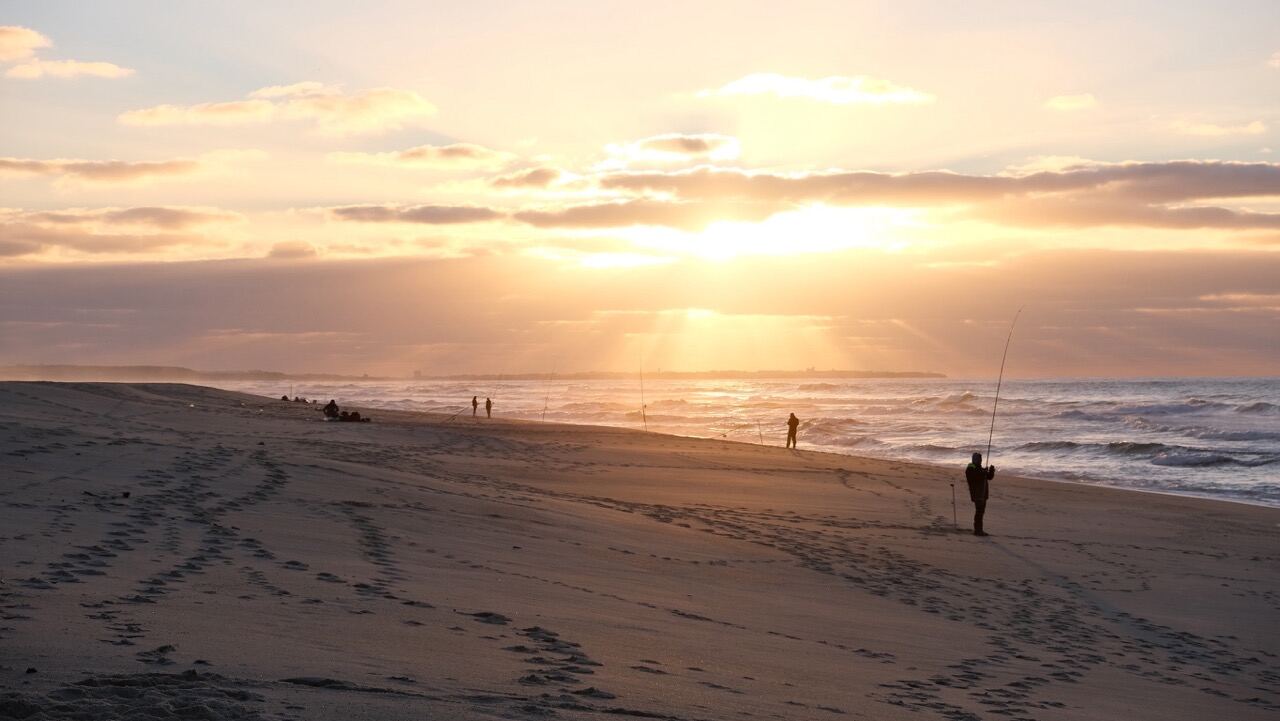
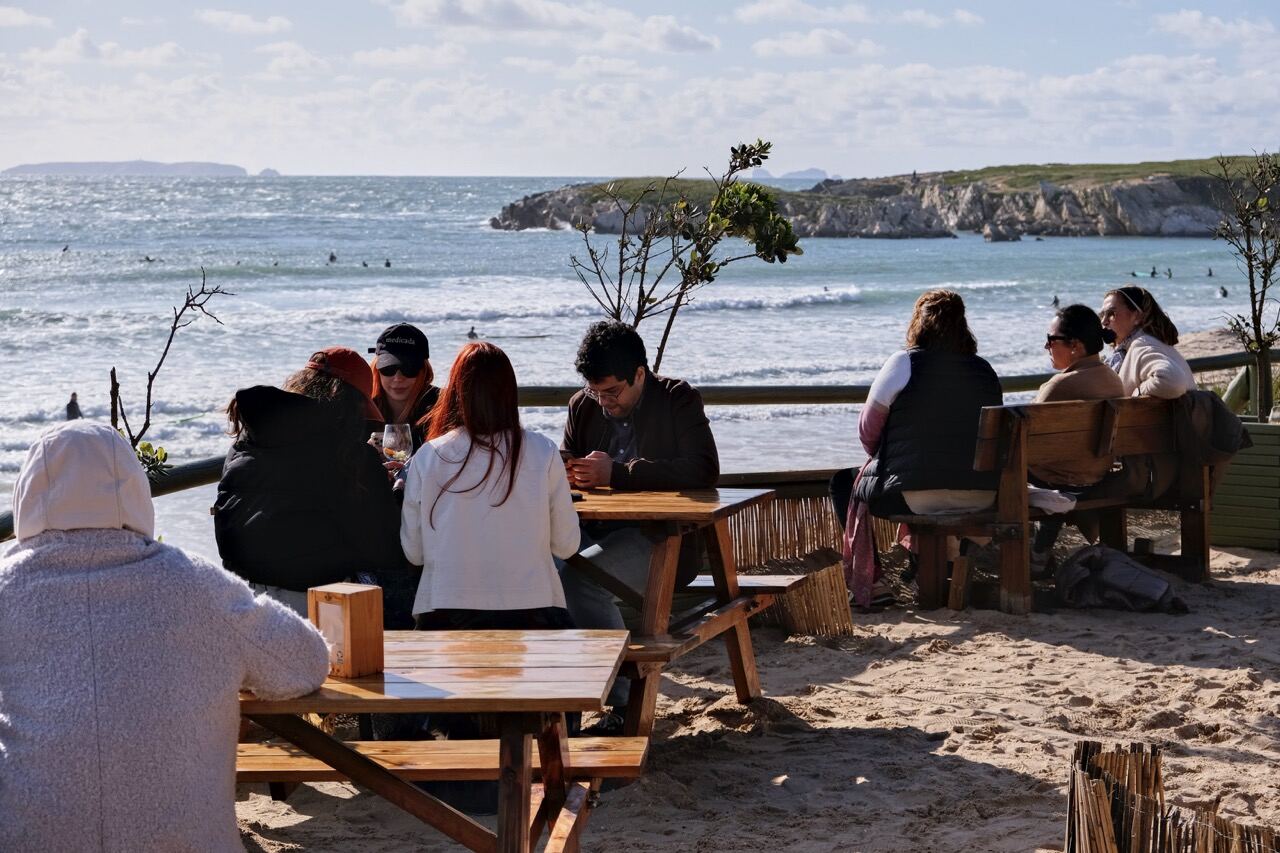
The lagoon mouth at Foz do Arelho is the place, and it is one of the best on this coast: the water goes gold, the Berlengas sit on the horizon, and the wind that ruined the afternoon drops away. Two bars face it. Inland there is no sunset to speak of, which is a reason to keep the car keys by the door.
- Ala Norte: the beach bar at Foz do Arelho facing the ocean and the Berlengas, open from ten in the morning.
- Cais da Praia: the terrace at the lagoon mouth, with live music on summer nights and dinner after.
Nightlife
Very little, and for most people who move here that is the point. A ginja in the bar on Rua Direita, a wine and some tapas until eleven, the hotel bar at Foz do Arelho in the summer, and that is the town. Caldas has a handful of bars that stay open later and a student crowd from its art school. For anything more, Lisbon is an hour away and the last bus is long gone, so it is a taxi or a bed.
- Bar Ibn Errik Rex: the ginja bar on Rua Direita, on the state's register of historic shops, open to midnight, closed Tuesdays.
- Vintage Tapas & Wine Bar: wine and small plates until eleven, the steadiest late table inside the walls.
- Água d'Alma bar: the hotel's terrace bar over the lagoon at Foz do Arelho, the coast's one reliable evening room.
Activities
Beaches
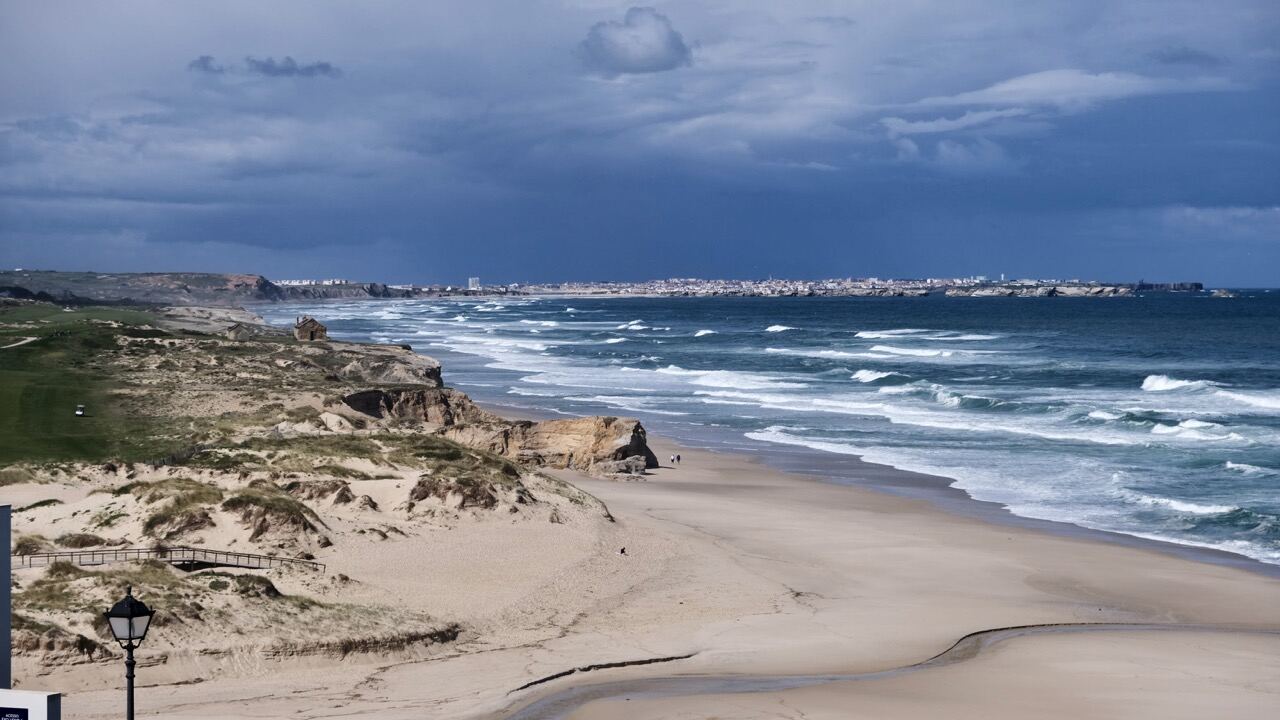
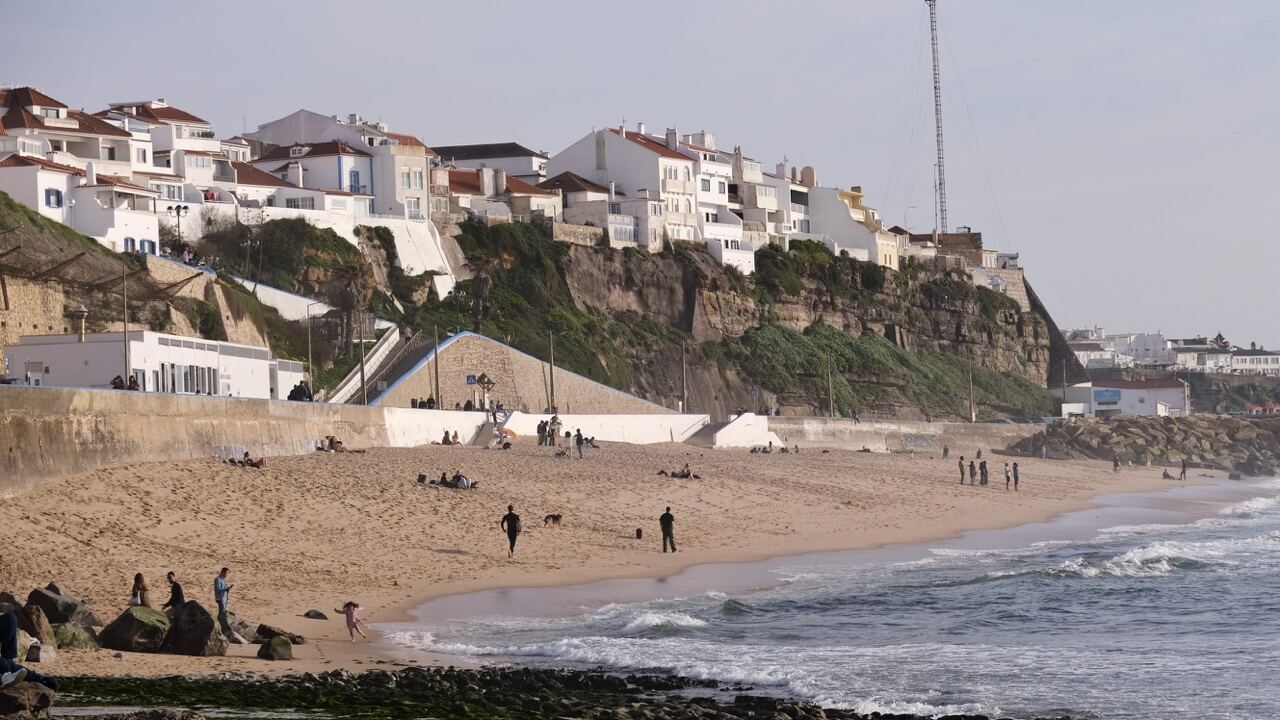
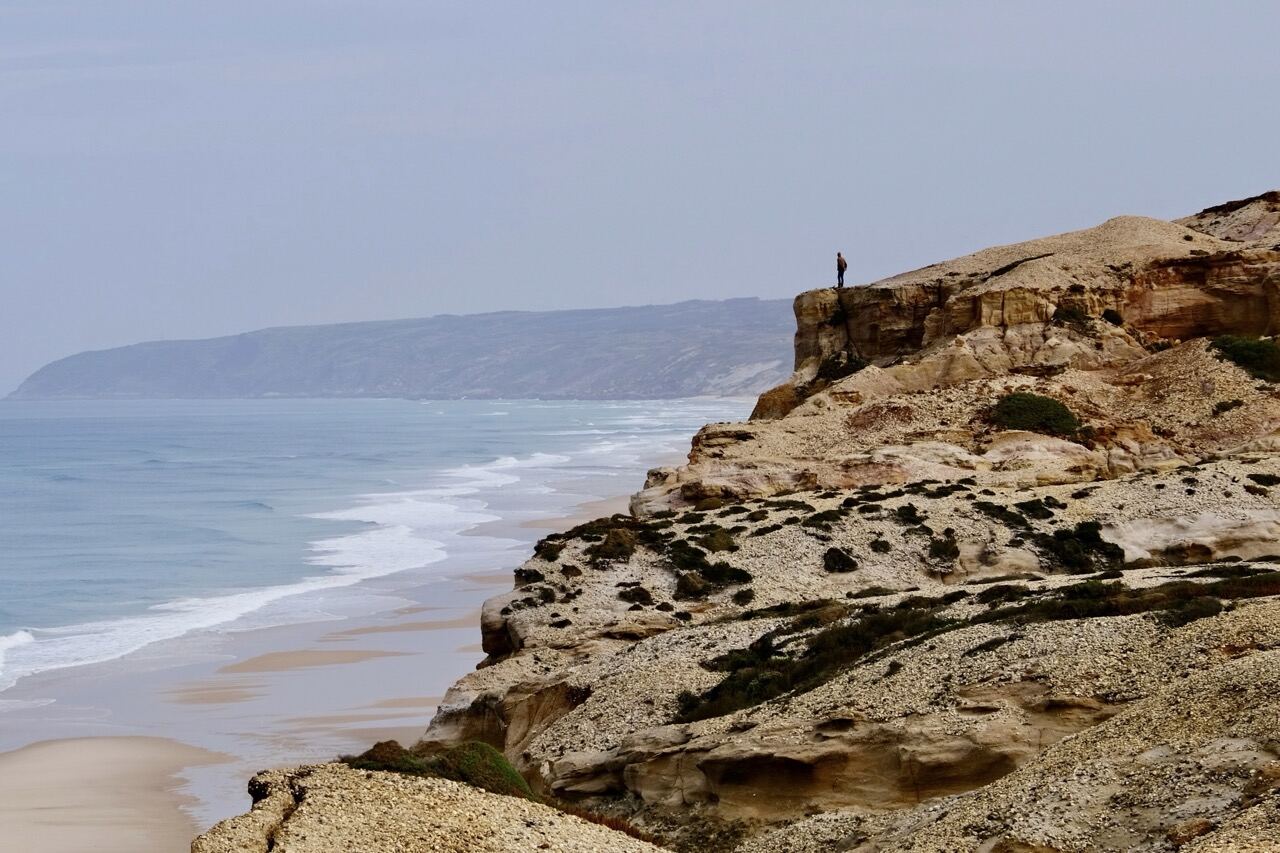
Four Atlantic beaches within fifteen minutes, all of them wide, cliff-backed and windy in the afternoon, and behind the first of them the lagoon, which is a different world: shallow, warm and calm. That pairing is the reason families choose this stretch. Lifeguards are on the main beaches from June to September, the water is Atlantic all year, and the afternoon wind empties the sand as reliably as it does further south. North to south:
- Foz do Arelho: the wide surf beach at the lagoon mouth, with the calm lagoon behind the dune, cafés, parking and the only real village on the coast here.
- Praia do Rei Cortiço: the next cove south, smaller and quieter, reached down a track.
- Praia D'El Rey: long, cliff-backed and empty out of season, with the golf resort and hotel above it.
- Praia dos Covões: the southern end, the emptiest of the four, and a walk from anywhere.
- Lagoa de Óbidos: not a beach but the reason to be here, a shallow tidal lagoon with warm water, no waves, and a shore you can walk round in an afternoon.
The lagoon
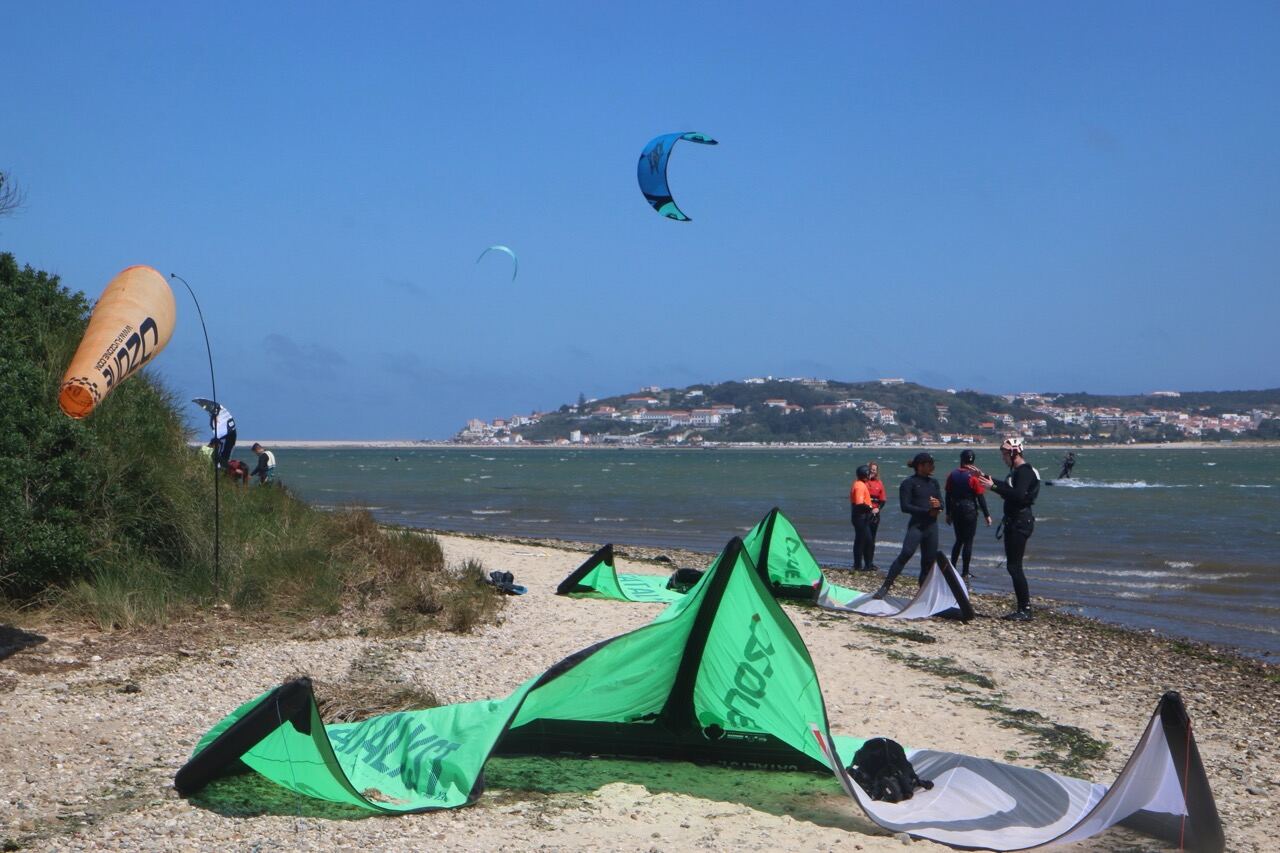
Portugal's largest coastal lagoon sits between the town and the sea: eight kilometres of shallow, sheltered water that warms up in a way the Atlantic never does, with a steady afternoon wind funnelling in off the coast. That combination, flat water and reliable breeze, is why the sailing school has been here since 1997 and why kitesurfers drive an hour from Lisbon rather than fight the sea. Children learn to sail here in a week, adults learn to kite here in three days, and on a summer evening the water is full of both.
The lagoon is tidal and the channels move, so the sailing school's advice on where to launch is worth taking before your own reading of the water is. Swimming is safe on the inner shore and unwise near the mouth, where the tide runs hard.
- Escola de Vela da Lagoa: at Nadadouro on the lagoon's south shore: sailing, windsurf, kite, wing and paddleboard courses for all ages.
- Kite Control: the kite school and shop on the south shore, with IKO instructors and lessons from first flight to foil.
- Kitesurf Soul: the smaller school on the same water, certified by the sailing federation, private lessons and hire.
Golf
This is one of the reasons people move here, and it is not a small one: three championship courses within fifteen minutes, two of them on the cliffs above the beach, at a fraction of what the Algarve charges for the same standard. The links at West Cliffs and Praia D'El Rey are the pair that draw the golf press, and Royal Óbidos sits inland with its own hotel and spa. Between them they support a whole layer of the local foreign community, and if you play, the club is also where you will meet people.
- West Cliffs and Praia D'El Rey: two championship links on the cliffs ten minutes from the town, with the beach below them.
- Royal Óbidos Spa & Golf Resort: the third eighteen holes, inland, with a hotel, a spa and a clubhouse.
Walking and cycling
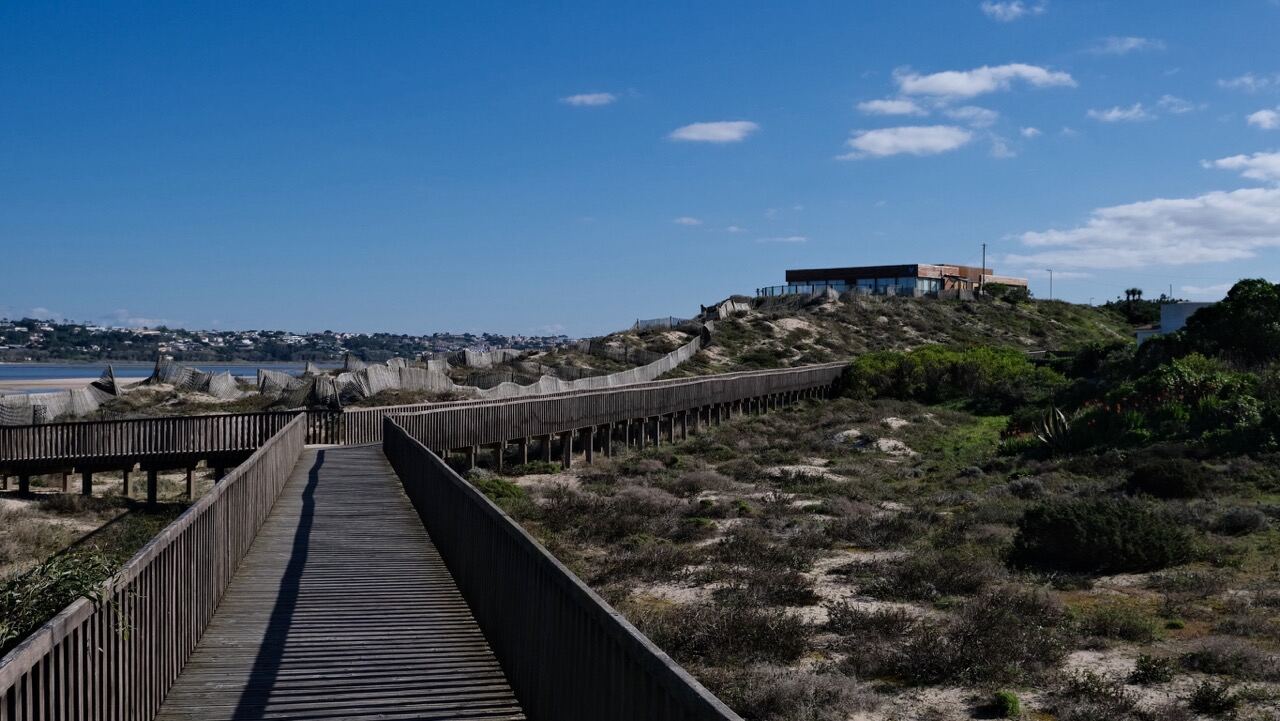
Gentler country than the cliffs further south, and better for it. A path runs the whole shore of the lagoon, flat and about fifteen kilometres round, which is the walk residents do most; the cliff tops from Foz do Arelho north towards Nazaré are wilder and mostly empty. Inland the lanes run through orchards and vines between the villages, quiet enough to cycle on and hilly enough to be exercise, and the mountain-bike club rides the hills behind the town at weekends. In summer, morning or evening, since there is no shade and the afternoon wind is unkind on a bicycle.
The walled town
Once you live here the walls become a thing you take visitors to, and the trick is knowing when. Early morning before the coaches, or an evening in the off season, and it is one of the loveliest small places in Portugal: you can walk the full circuit of the ramparts, the castle is a hotel, and the lanes are empty. The rest of the year it belongs to the festivals, which are genuinely good and genuinely crowded. Chocolate in March, medieval in July, opera and literature in between, and the Christmas town from late November, which is the biggest of them all and turns the place into a fairground for six weeks.
- Festival Internacional de Chocolate: the spring festival, Fridays to Sundays in March, about €10 to get in, and the year's biggest crowd.
- Óbidos Vila Natal: the Christmas town from late November to early January, rides and stalls, which fills the winter.
Visiting
36 hours in Óbidos
In the manner of the New York Times column: arrive Friday afternoon, leave Sunday, and use the weekend to test the area before you decide. Every stop is chosen to answer a question a future resident has, not a visitor.
Come outside the festivals if you can, and outside August: May, June or late September, when the coaches thin out, the coast is open and the lagoon is warm.
Friday
- 6 pm The walls, when they are empty. Park outside Porta da Vila and walk the full circuit of the ramparts as the last coaches leave. It takes forty minutes, there is no handrail, and it is the one hour of the day when the town is what the photographs promise.
- 8 pm Petrarum Domus. Dinner on Rua Direita at the one table inside the walls that publishes its prices and cooks for people who live here. Mains €12 to €27.
- 10 pm Bar Ibn Errik Rex. A ginja in the crowded little bar on the state's register of historic shops. This is the whole of the town's nightlife, so judge it now.
Saturday
- 8.30 am Praça da Fruta, Caldas da Rainha. Fifteen minutes to the market that will feed you if you move here: the growers' own produce in the open square, the fish market beside it. Buy breakfast and eat it standing up, and look at the town while you are there, because this is the one you will actually use.
- 11 am On the lagoon. A dinghy or a paddleboard from the sailing school at Nadadouro, or a kite lesson if the wind is up. Two hours on flat warm water with the wind rising tells you whether the thing everyone talks about here is for you.
- 2 pm Cabana do Pescador. Fish by weight on the lagoon front at Foz do Arelho, the restaurant that stays open all year, which on this coast is the recommendation.
- 4 pm The beach and the cliffs. Over the dune to the ocean side, then drive south past Praia D'El Rey to the cliff tops. Empty, wide and windy, and nothing like the lagoon you were on two hours ago. The two waters within a kilometre of each other are the whole argument for this coast.
- 7 pm Ala Norte. A drink at the beach bar facing the Berlengas as the sun goes down and the wind drops. Stay for dinner at Cais da Praia next door if you cannot face moving.
Sunday
- 9.30 am Round the lagoon. The flat path along the shore, an hour out and back from Foz do Arelho, with the herons and the oyster beds and the town on its hill in the distance. This is the walk you would do most weeks.
- 12 pm The villages. Drive Gaeiras, Usseira, Amoreira and A-dos-Negros, which is where people who live here actually live. Look at the houses with land, the distance to the school and the shop, and how far you are from the A8. Lunch at the tasca in whichever village you liked best.
- 3 pm Golf, or the monasteries. Nine holes on the cliffs at West Cliffs if you play, or drive twenty-five minutes north to Alcobaça and Batalha, two of the great Gothic buildings in Europe and half empty on a Sunday afternoon. Then the A8 south, an hour to the airport.
Explore the surroundings
The Silver Coast is the least visited good coast in Portugal, and Óbidos sits in the middle of it. Everything below is within an hour, and the first two are places you will go every week rather than once.
- Caldas da Rainha: fifteen minutes, the working town: the daily market, the hospital, the shops and the ceramics it is famous for.
- Peniche and Baleal: half an hour south-west, the fishing port and the surf coast, and the boat to the Berlengas in summer.
- Nazaré: forty minutes north, a working fishing town, and in winter the canyon that throws up the biggest waves ever surfed.
- Alcobaça and Batalha: twenty-five and forty minutes north, two Gothic monasteries on the world heritage list and rarely crowded.
- Ericeira: an hour south, the surf reserve, for a day when you want a busier town and better coffee.
- Lisbon: an hour on the A8, for a concert, a museum, a late dinner and the airport.
Hotel recommendations
Two obvious bases, and they point at the two halves of the decision. Sleep inside the walls to understand the town, or on the lagoon to understand the coast; if you are here to look at houses, the lagoon is the more useful of the two.
- The Literary Man: 27 rooms in a nineteenth-century convent inside the walls, with a bar and some sixty thousand books.
- Água d'Alma: on the lagoon at Foz do Arelho, from about €84 a night out of season, and the better base for viewings.
Sources
Sold pricesexactmunicipalINE, Estatísticas de preços da habitação ao nível local, indicator 0012234: the median deed price per square metre of every home sold in the trailing twelve months, by municipality and parish, refreshed from INE's API each quarter. Deed prices, not asking prices.
IMI, tourist tax and containmentexactmunicipalIMI: Óbidos council, 0,36% on urban property for 2026. Tourist tax €1,50 per person per night, up to 5 nights. No containment areas.
Figures calibrated 2026-08.