Peniche
A working fishing port with a surf reserve of its own at Baleal, cheaper than Ericeira and quieter in winter.
Updated 14 September 2026
The short version
- A working fishing port on a peninsula 90 km north of Lisbon, with the A8 to the capital in about an hour, the airport an hour and a quarter, and surf on both sides of the headland.
- Suits surfers, remote workers who want waves in February, and anyone who prefers a real Portuguese town to a resort. Does not suit anyone who wants polish, warm water or an international school.
- Asking prices around €2.500 per square metre; a two-bedroom flat rents for about €900 a month, a house for about €1.400.
- Peniche council: IMI 0,31%, no tourist tax, and no limits on new short-let registrations.
- The one thing everybody says: the wind. The peninsula sticks out into the Atlantic and the summer northerly blows hard across it most afternoons, which is also why one side is always surfable.
The town
What it is like to live there
Peniche is a peninsula with a fishing port on it, and everything else follows from that. It is Portugal's biggest sardine and shellfish harbour, the boats go out at night and the fish auction runs at dawn, and the canning trade is still an employer. The council likes to call it the capital of the wave and the surf is genuinely world class, but the economy is fish first. That is the difference between here and the surf towns south of it, and it is why the prices are half theirs.
The town is not pretty in the way Óbidos is pretty. It is a walled centre with a fortress at the end of it, then sixties and seventies apartment blocks, then the industrial edge of the port. What it has instead is a working life that does not stop in winter, an Atlantic on three sides, and a peninsula shaped so that whatever the wind is doing, one coast is always sheltered. Most foreign residents end up not in the town but at Ferrel, the village behind Baleal, which is where the surf community and the remote workers have quietly settled.
The weather is exposed. Winters run 10 to 16 degrees and are wet enough; summers sit around 20 to 26, cooler than inland because the sea is on every side. The constant is the nortada, the north wind that gets up most summer afternoons and is stronger here than anywhere else on this coast, because there is nothing to stop it. Newcomers underestimate it every single time.
Tips and tidbits
The short list of what you learn in the first month.
- The peninsula's shape is the point. When the north wind blows out the north side, Consolação and the south coast are clean, and the other way round in a southerly. Learn which beach goes with which wind and you can surf here every day of the year.
- Most people who move here live at Ferrel, not in Peniche town and not in Baleal. Village houses with land, five minutes from the waves, ten from the supermarket, and it stays alive in January.
- Baleal is beautiful and it is empty from November to March. Half the businesses shut. Look at it in winter before you commit to it.
- The fish smell from the processing plants is real on the wrong breeze, mostly on the harbour side of town. Stand outside a house at different times of day before you sign.
- The hospital in town does basic emergencies only. Anything serious goes to Caldas da Rainha, half an hour away, and that is the drive to time on a viewing.
- The fish auction at the harbour, the lota, is worth getting up for once, and the market in town runs Tuesday to Sunday mornings.
- Supertubos is not a beach to learn on and not a beach to swim at. It is shallow, it closes out and it hosts a world championship event in October. Cantinho da Baía is where everyone actually learns.
- Restaurants close a weekday, most often Monday. Baleal's close for the season entirely.
- There is no international school here. The nearest English-medium option is half an hour away in Caldas and it is a hybrid, not a campus. Settle this before the house.
- The boat to the Berlengas runs May to September only, with a daily cap on visitors. Book it, do not turn up.
Getting there and getting around
The A8 puts Lisbon about an hour and five minutes away and the airport an hour and a quarter, with tolls. The 786 coach runs from the town to Lisbon's Campo Grande in an hour and twenty to an hour and forty, several times a day, which is the sensible way in if you are not carrying boards. There is no useful train.
In Peniche town itself you can live without a car: it is flat, small and walkable, and the harbour, the market and the beaches are all within twenty minutes on foot. For Baleal, Ferrel, the school run and the hospital at Caldas you will want one, and if you surf you will want a roof rack more than a garage.
Honest downsides
The wind is relentless, and that is the word residents use. The fish-processing smell drifts across parts of the town on the wrong breeze. Some of Peniche is tired and industrial in a way that photographs badly and lives fine, but you should see it before you decide. There is no international school and the hospital handles basic emergencies only, so families and anyone with a health condition are making a real trade. Baleal in August is a crush of vans and surf schools, and Baleal in January is shuttered. And the water is cold, all year, with no exceptions.
Living in Peniche
Residence and paperwork
There are two routes in. An EU citizen needs no visa: you arrive, and after three months you register as a resident at the council in Peniche with a passport and proof of an address. Everyone else applies at a Portuguese consulate before travelling, most often for the D7, for people living on a pension or other income that arrives whether they work or not, or the D8, the digital-nomad visa, for remote workers who can show earnings of about four times the Portuguese minimum wage. Either becomes a residence permit once you are here, issued by AIMA, whose appointments are the slow part of the whole business and the reason people start a year ahead.
The order that saves the most time: the tax number, the NIF, first, because a bank account, a lease, a phone contract and the electricity all ask for it; then a Portuguese bank account; then the rental contract, which is what proves the address; then the residence registration, and only then the health centre. A lawyer to run the appointments costs a few hundred euros and is worth it for a first move from outside the EU.
- Portuguese visas: the foreign ministry's portal, where the D7 and D8 conditions and the consulate appointments live.
- AIMA: the agency that issues and renews the residence permit once you are in the country.
Housing
Three markets on one small peninsula. Peniche town is the cheapest and most urban: sixties to eighties apartment blocks, some old fishermen's houses inside the walls, everything walkable, and the most worn. Baleal is a sandy isthmus village that is almost entirely holiday lets and surf houses, the highest price per square metre and dead in January. Ferrel, just inland behind Baleal, is where most residents actually settle: village houses with land, a school, a couple of good cafés, quiet, five minutes from the waves.
Asking prices average around €2.500 per square metre, the lowest on this site, and rents run about €900 a month for a two-bedroom flat, €1.400 for a house and €2.200 for a villa with a pool. Long lets are scarce in summer, when everything goes to the surf trade, and much easier from October. The pattern here is to arrive in autumn, take something for the winter, and look properly once you know the wind.
- Peniche town: flats and old fishermen's houses, walkable, the cheapest, and the port on your doorstep.
- Baleal: the isthmus village, surf houses and holiday lets, the priciest and the emptiest out of season.
- Ferrel: village houses with land behind Baleal, where the residents are, and alive all year.
- Atouguia da Baleia and the inland villages: the most Portuguese and the cheapest of all, ten minutes from the sea.
- Idealista: the portal most listings reach first, in English, and the one that covers Ferrel and Atouguia as well as the town.
- Imovirtual: the second portal, worth a look because some agents post to one and not the other.
- Casa Sapo: the older Portuguese portal, and often the first with a village house inland.
Cost of living
For one person renting a two-bedroom flat, a comfortable month runs about €1.600 to €2.000, the cheapest of the coastal towns on this site. A family of four in a house sits nearer €2.800 to €3.600 without school fees. Fish is cheap and excellent because you are standing next to where it lands. The rents in the table come from the market data and move with it; the rest is what the town charged when the guide was last updated.
| What things cost | |
|---|---|
| Rent, a two-bedroom flat, unfurnished | €900 a month |
| Rent, a house | €1.400 a month |
| Rent, a villa with a pool | €2.200 a month |
| A coffee at the counter | €0,80 to €1,20 |
| The lunch plate, with bread and a drink | €8 to €13 |
| Dinner for one, fish and wine | €25 to €40 |
| A beer on a terrace | €2 to €3,50 |
| Groceries for one, a month | €250 to €350 |
| Electricity, water, gas and internet, a month | about €110 |
| A coworking desk, a day | €7 to €12 |
| A surf lesson | €35 to €45 |
| The boat to the Berlengas, return | €19,90 |
Health
Public
The national health service, the SNS, covers anyone resident: you register at the family health unit in the town with your tax number and proof of address, get a user number, and wait for a family doctor. The hospital in Peniche handles basic emergencies and little else; the full emergency department is at Caldas da Rainha, half an hour down the road, and anything major goes on from there. That is the single biggest practical weakness of this town and it deserves a moment's honest thought, particularly for anyone older or with a condition that flares.
- USF Marés: the public family health unit on Rua General Humberto Delgado, where you register for a doctor.
- Hospital de Peniche: the local hospital, basic emergencies only; the full emergency department is at Caldas da Rainha.
Private
Private care fills the everyday gap. There is a long-established private clinic in the town with a dozen or so specialties, a consultation runs €50 to €90, and appointments come within days. Insurance is priced by age and plan rather than income, from about €30 a month at thirty to over €100 at sixty, with a co-payment on each visit and exclusions for what you already have. For anything the town cannot do, Caldas is thirty minutes and Lisbon is an hour.
- Clínica Médica Doutora Fátima Peralta: the private clinic in town since 1984, with fifteen specialties.
Shopping
Markets
The municipal market runs Tuesday to Sunday mornings and the fish in it came off a boat a few hundred metres away, which is the single best thing about shopping in this town. The fish auction at the harbour is a working auction rather than a spectacle, and worth seeing once at dawn.
- Mercado Municipal de Peniche: fish and produce on Rua António Conceição Bento, Tuesday to Sunday mornings.
Shops
The high street is ordinary and serves the town rather than visitors, which after Óbidos or Sintra is a relief. Surf shops are the one category in surplus, and between Peniche and Baleal there are more of them than anywhere in Portugal outside Ericeira. For furniture, appliances and anything larger, Caldas da Rainha is half an hour and Leiria an hour.
Supermarkets
Unusually for a town this size, all four chains are here: a big Continente by the hospital, a Lidl and an Aldi on the same street, an Intermarché and a Pingo Doce. The weekly shop needs no trip out, which the villages around cannot say.
- Continente Modelo Peniche: the biggest supermarket, beside the hospital, open until ten.
Schools
The state schools cover the peninsula through three groupings, from pre-school to the end of the third cycle, free and taught in Portuguese, with the secondary years in the town. They are ordinary Portuguese state schools and children under about ten pick the language up within a school year.
There is no international school in Peniche, and that is the fact most likely to decide a family against it. The nearest English-medium option is a hybrid academy for twelve to eighteen in Caldas da Rainha at about €7.100 a year, which is not a campus school; the nearest bilingual one is also in Caldas. Real international schooling means the Lisbon area, an hour each way, which nobody sustains as a daily run. Settle this before you settle on a house.
- Agrupamento de Escolas de Peniche: the main state grouping, pre-school to the third cycle, with two more groupings covering the rest of the council.
- Colégio Rainha D. Leonor: the bilingual school with a Cambridge stream at Caldas da Rainha, half an hour away.
Coworking spaces
More than the size of the town suggests, because the surf colivings built it: an independent space with a makerspace in the town, and three places at or near Baleal that rent desks by the day or bundle them with a room. Day rates are the cheapest on this site, from about €7 for a half day. Fibre reaches the town, Ferrel and Baleal, and the connection is better than the industrial edge of the place would lead you to expect. Out in the inland villages, test it on the viewing.
- Largo Space: the independent space in Peniche town, with a makerspace attached.
- Swelldesk: coliving and coworking near Baleal, with desks and a room for calls.
- RIDE Surf Resort: at Baleal, desks by the day at €7 for a half day and €12 for a full one.
- Onda Coliving: beachfront coliving with work desks, two minutes from Baleal.
Community
Two communities that overlap less than you would think: the Portuguese town, which is old, tight and built around the port, the football and the church; and the surf and remote-work community, which is young, foreign and centred on Baleal and Ferrel. The second is easy to join and the first takes Portuguese and time. The town also has a small but real ocean-technology scene, which is unusual for somewhere this size and is worth knowing about if you work in that world.
The beach-cleanup association is the most open door in the area and takes anyone who turns up, which makes it the fastest way to meet both communities at once. The sailing and diving club has been going since 1956 and runs courses. Beyond that it is WhatsApp groups by village and by lineup, and you are added by a person rather than a link.
- Ocean Patrol Association: beach cleanups anyone can join, over a thousand volunteers, based at Bufarda.
- Clube Naval de Peniche: the sailing and diving club since 1956, with schools and skipper courses.
- Peniche Ocean Watch: the ocean-technology hub, and the founder and remote-worker network attached to it.
Taxes
On the home
Buying costs about seven percent on top of the price: the transfer tax, IMT, on a sliding scale that reaches 7,5% for a main home, stamp duty of 0,8%, and the notary and registry. Since May 2026 a buyer who is not resident in Portugal pays 7,5% on the whole price instead: a resident meets that rate only on the slice above about a million euros, so on a €500.000 home the non-resident pays roughly twice the tax. Then every year the council's property tax, IMI, at Peniche's rate of 0,31% of the tax office's valuation, which usually sits well below the market price. A first home can be exempt from IMI for three years.
On your income
You become tax resident after 183 days in a year, or sooner with a home you keep as your habitual one, and then pay two things on what you earn. Income tax, IRS, on worldwide income at progressive rates from 12,5% to 48%, with a 2,5% solidarity charge above €80.000. And social security: an employee pays 11% of gross and the employer 23,75% on top; a freelancer on recibos verdes pays 21,4% on 70% of what was invoiced, declared quarterly, with the first year exempt, and a remote worker paid by a foreign employer is normally treated as one. Contributions buy the state pension, sick pay and parental leave, not the health service, which comes with residence; EU citizens can stay on their home system for a while on an A1 certificate, and foreign pensions carry no contributions but are taxed at the normal rates. The old non-habitual resident regime closed to newcomers in 2024; its successor, IFICI, gives a flat 20% income tax for ten years to people in listed scientific, technical and start-up roles, applied for in the first year. Before any of it comes the tax number, the NIF, a morning at the tax office or a lawyer's fee from abroad.
What that means for a freelancer invoicing €100.000 a year, taxed on 75% of it under the simplified regime, with and without IFICI. An accountant costs €100 to €200 a month and, at these sums, earns it.
| A freelancer's year | Standard | Under IFICI |
|---|---|---|
| Invoiced | €100.000 | €100.000 |
| Social security, 21,4% of 70% of it | − €15.000 | − €15.000 |
| Income tax on 75% of it, progressive or flat 20% | − €25.000 | − €15.000 |
| Left | about €60.000 | about €70.000 |
A rough calculation on the 2026 tables, before the deductions for children, rent and health, rounded to the thousand. Not tax advice: the rules move with every budget, so check the date at the top of the guide.
- Portal das Finanças: the tax authority's portal, where the NIF, the IMI bills and the yearly return all live; in Portuguese, with an accountant's help worth its fee in the first year.
On a short let
Renting out by the night is business income, declared under category B, with a simplified regime that taxes a fraction of the gross for smaller operators, and no tourist tax, which not every council can say. The registration, the AL, is open in Peniche without a cap, which is not true of Lisbon or Porto. A long let is taxed at a flat 25% on the rent, less for contracts of five years or more.
Eating and drinking
Breakfast
A thin but genuine specialty layer on top of a town that mostly drinks a coffee at a counter for eighty cents. There is a nanoroaster at Ferrel that also pours natural wine, an artisan bakery in the town doing its own croissants, and a square café that opens all year until midnight and is where the town actually sits. Both of the first two close a couple of days a week, which is what happens at that scale.
- sol: the nanoroaster at Ferrel, specialty coffee and natural wine, the only own roast in the area.
- Quint'æssencia: an artisan bakery in the town, hand-made croissants and matcha, closed early in the week.
- Cafetaria Puro Cake Lab: the square café the town uses all year, open until midnight.
Lunch
The cheap meal and the best value on this coast, because the fish has not travelled. A plate with bread and a drink runs €8 to €13 in the back streets, and the harbour tascas do a fish soup that is a meal on its own. Sitting at a plastic table beside the boats eating something landed that morning for twelve euros is the argument for Peniche in one sentence.
- Cantinho do Bolha: the cheapest proper sit-down in town, €10 to €15, and the fish soup, closed Sundays.
- O Sebastião: a small back-street place residents rate highly, €20 to €25, closed Mondays.
- Abrigo do Pescador: on the harbour at Largo da Ribeira, thirty-three years of charcoal-grilled fish.
- Tasca da Ribeira: a rough-and-ready harbour tasca, €10 to €15, and open late.
Dinner
Shellfish is what the town is for. The marisqueiras do percebes, the gooseneck barnacles picked off these rocks, along with crab, clams and whatever the boats brought in, at about €30 to €40 a head. The name residents give first is a small seafood place that needs booking and closes at the start of the week. Out at Baleal there is a family room that has been going since 1957 and takes no reservations, so you queue in summer.
- Tasca do Joel: the name residents give first, seafood at about €30 a head, closed Mondays and Tuesdays, book ahead.
- Mirandum: the marisqueira for percebes and shellfish platters, about €35, closed Mondays.
- Marginal: the highest-rated in the town, modern seafood, €20 to €40, closed Mondays.
- Taberna do Ganhão: family-run at Baleal since 1957, €20 to €40, no reservations and a queue in summer.
Sundowners
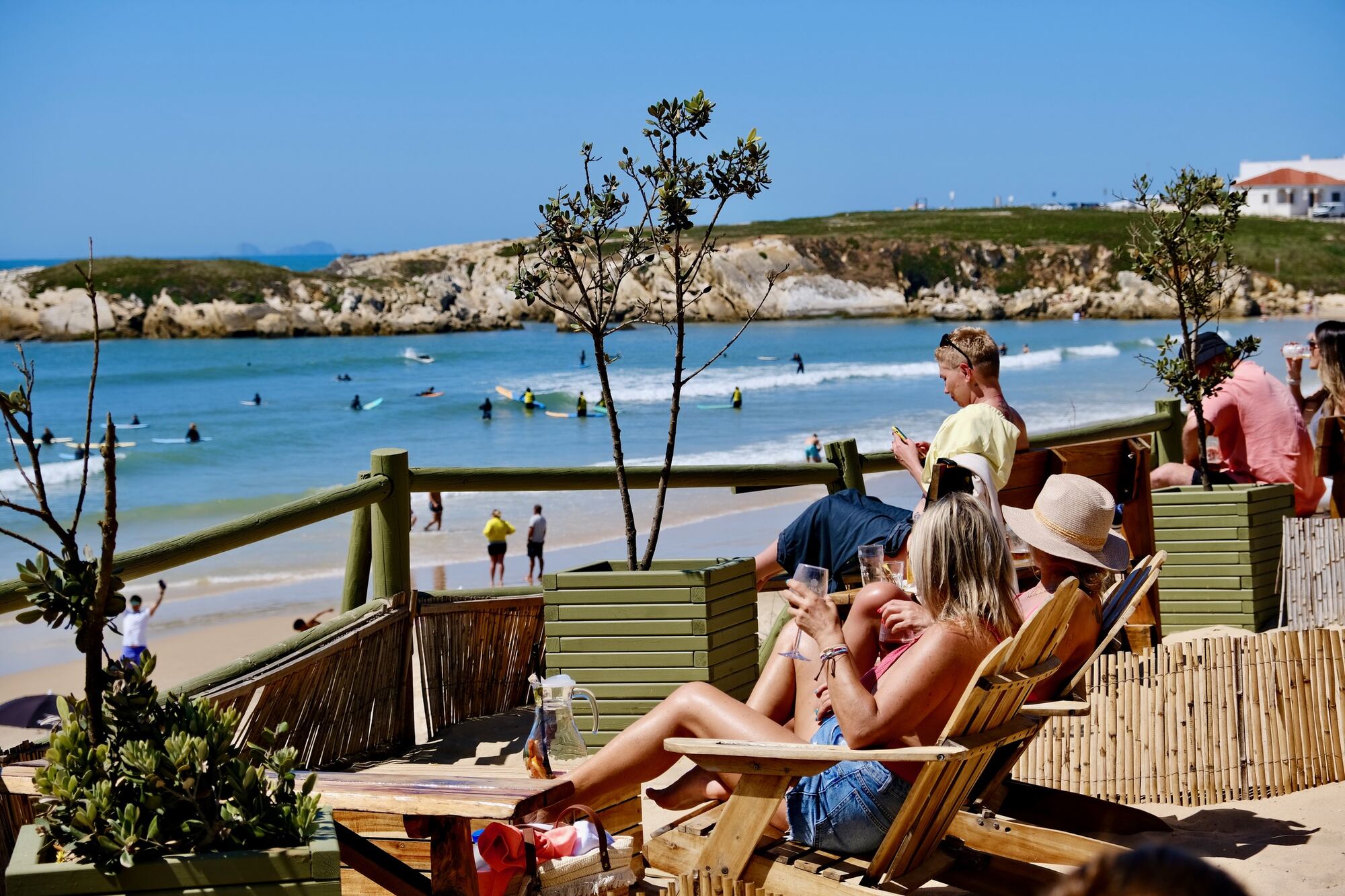
The peninsula faces west on one side and the sun goes into the sea in front of Baleal, which is where everyone goes. The beach terraces there are the summer institution. On the south side the bar on the harbour wall looks straight down the Supertubos sandbank, which is a different and better kind of view if there is a swell running: you watch the waves rather than the sunset.
- Tribo da Praia: the Baleal beach terrace facing the sunset, food and drinks, weighted to the summer.
- Xakra Beach Bar: on Molhe Leste looking straight down the Supertubos sandbank, which is the view when it is breaking.
Nightlife
Concentrated at Baleal and concentrated in summer. The beach bar there runs DJs until four in the morning in season, there is a small cocktail bar that opens at six and is the grown-up option, and a long-standing beach bar beside them. In the town itself there is very little, and in winter there is almost nothing anywhere: the surf camps empty and the bars follow. For a real night out it is Caldas, or Lisbon and a bed.
- Danau Beach Bar: the late one on Baleal beach, DJs and dancing until four in season.
- The Base: Baleal's grown-up bar, proper cocktails, small, opens at six, closed Mondays.
- Bar da Praia: the long-standing beach bar facing the ocean, seasonal.
Activities
Beaches
The peninsula gives you two coasts a kilometre apart facing opposite ways, which is the whole geography of the place: when the north wind ruins one side, the other is glassy. The south side is the harbour, the fortress and the famous heavy waves; the north side is the long sand of Baleal and the beaches running away towards Óbidos. Water is Atlantic and cold all year. South to north:
- Praia da Consolação: south of the peninsula, a sheltered reef and a beach that works when everything else is blown out, with an old spa village behind it.
- Supertubos: a kilometre of sand and the heaviest wave in Portugal, shallow and barrelling, a world championship venue every October, and no place to swim.
- Molhe Leste: beside the harbour wall, a punchy right, the town's own beach and the easiest to reach on foot.
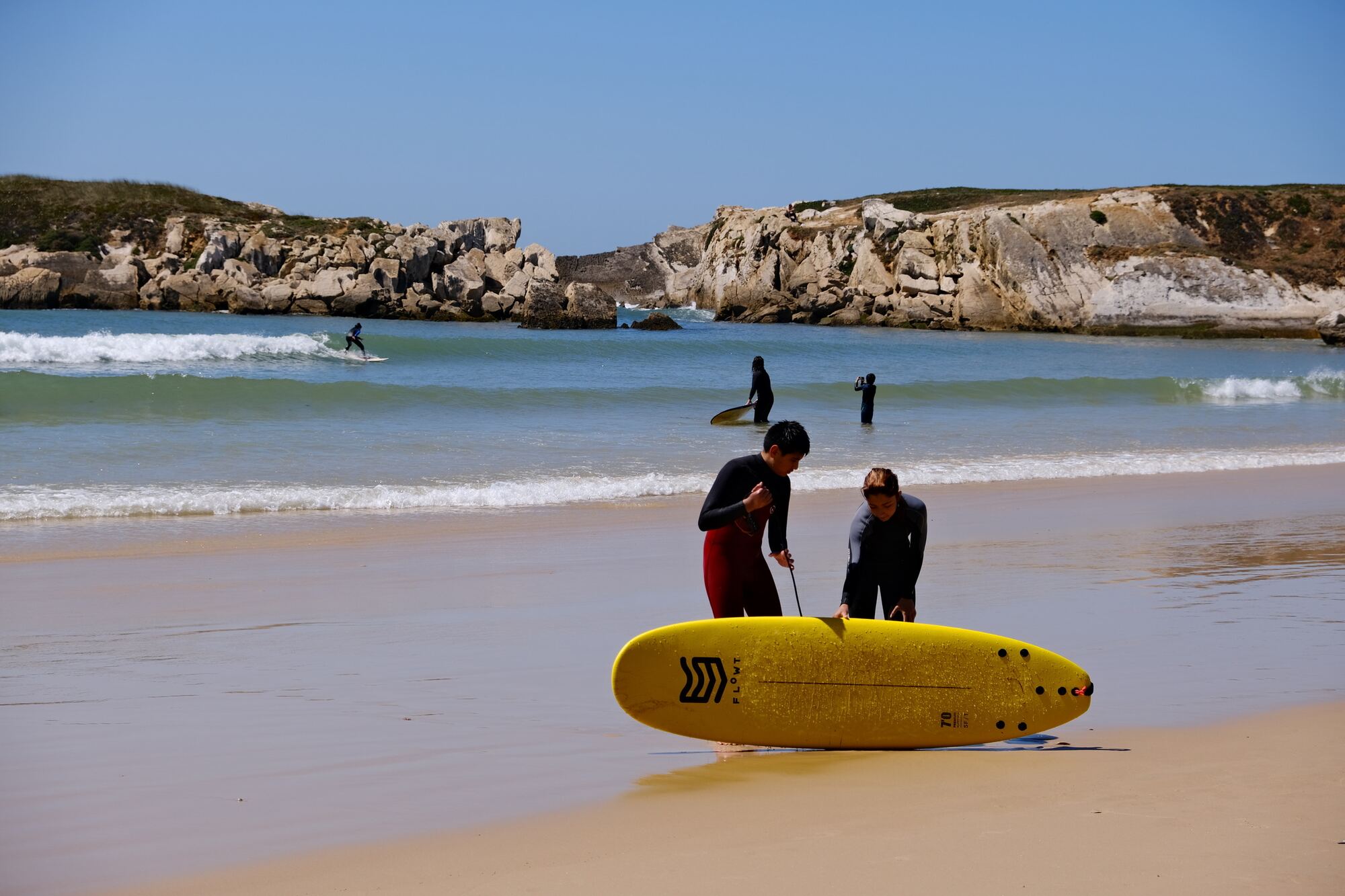
- Cantinho da Baía and Baleal Sul: the sheltered bay on the south side of the Baleal isthmus, sand-bottomed and forgiving and out of the north wind, where every surf school in the region teaches.
- Lagide, Prainha and Gigi: the reefs strung along the north side of the Baleal isthmus, short and crowded and for people who already surf, with Gigi the most forgiving of the three.
- Almagreira and Peniche de Cima: the long open beaches running north, exposed, heavy and almost always empty.
Surf
One of the two or three best places to surf in Europe, and the reason is the shape of the land rather than the size of the swell. Because the peninsula points west with a coast on each side, there is nearly always somewhere clean: the north side works in a southerly, the south side in the prevailing summer northerly, and Consolação picks up the days when both are blown out. Autumn and winter bring the size, and the water sits between fourteen and eighteen degrees all year, so it is a wetsuit town in August.
The learning happens at Cantinho da Baía and Baleal Sul, the sheltered sand-bottomed bay on the south side of the isthmus, where a dozen schools work and Portugal's first surf camp opened in 1993. The other end is Supertubos, a shallow, fast, barrelling beach break that hosts a world championship event each October and hurts people who overrate themselves. Between them, Molhe Leste and the Baleal reefs give intermediates somewhere to progress to.
- Baleal Surf Camp: Portugal's first surf camp, opened 1993, federation-certified, teaching on Cantinho da Baía.
- Silver Coast Surf School: at Baleal, lessons and rentals, and one of the best-reviewed schools in the area.
- MEO Rip Curl Pro at Supertubos: the world championship event on the town's own sandbank, 16 to 25 October 2026.
The Berlengas and diving
Ten kilometres offshore there is a granite island with a fort on it, a biosphere reserve where the water is clearer than anywhere else on this coast, and a boat that takes forty minutes from the harbour. It runs May to September only, costs about €20 return, and the number of visitors a day is capped, so it is booked rather than turned up for. Going once is a day out; going in September when the crowd has gone is one of the best things about living here.
The same clear water makes this the best diving on the west coast: reefs, tunnels, caves and a set of wrecks, run out of the harbour by a long-established centre. It is cold and it needs a proper suit, and it is a genuine reason people choose Peniche over the prettier towns around it.
- Viamar, the Berlengas boat: forty minutes from Cais da Ribeira, about €20 return, May to September, with a daily cap on visitors.
- Haliotis Peniche: the diving centre in the harbour: the Berlengas reefs, the caves and the wrecks.
Walking and cycling
The walk everyone does is the circuit of the peninsula itself: out past the fortress to Cabo Carvoeiro, along the cliffs with the Berlengas on the horizon and the sea stacks below, and back by the north shore. It is about ten kilometres, flat, and different in every wind. North from Baleal the beaches run unbroken towards Foz do Arelho, which is a long empty walk on sand for as far as you have patience.
Cycling is easy going and hard coming back, because the peninsula is flat and the wind is not. The quiet lanes inland through Atouguia and Ferrel are the better ride, and there is a growing network of paths around the town.
In town
The fortress at the end of the peninsula was a political prison under the dictatorship and is now the national museum of resistance and freedom, which is the town's other identity and a serious piece of history rather than a diversion. Beyond it: the fish auction at dawn, the market, the lace-making the town has been known for since the seventeenth century, and the boatyards. The surf championship in October fills the place, and the Nossa Senhora da Boa Viagem festival in August puts the fishing boats out in procession, which is the one to see.
- Museu Nacional Resistência e Liberdade: the fortress and former political prison at the end of the peninsula, now the national museum.
Visiting
36 hours in Peniche
In the manner of the New York Times column: arrive Friday afternoon, leave Sunday, and use the weekend to test the town before you decide. Every stop is chosen to answer a question a future resident has, not a visitor.
Come in September or October if you can: the water is at its warmest, the swell has come back, the summer crowd has gone and the town is still open. February will show you the other truth, if you want it.
Friday
- 5 pm The peninsula and the fortress. Drive to the point at Cabo Carvoeiro, then walk back along the cliffs to the fortress, which was a political prison and is now the national museum of resistance. An hour, the Berlengas on the horizon, and the town's real history rather than its surf brand.
- 8 pm Tasca do Joel. The name residents give first: seafood, about €30 a head, and worth the booking. Note what that buys here compared with the Lisbon coast.
- 10.30 pm Xakra, on the harbour wall. A drink on Molhe Leste looking down the Supertubos sandbank in the dark, listening to it. If there is a swell running you will not want to leave.
Saturday
- 8 am sol, at Ferrel. Coffee at the nanoroaster in the village where most people who move here end up living. Look at the place while you drink it: the houses with land, the school, the fact that it is open in the first place.
- 10 am A lesson at Cantinho da Baía. The sheltered sand-bottomed bay on the south side of the isthmus where every school in the region teaches, with Portugal's first surf camp on it. Two hours in a wetsuit tells you more about the water temperature than any guide.
- 1 pm Cantinho do Bolha. Back into town for the cheapest proper lunch on this coast: a plate and a fish soup for about €12, in a room full of people who work here.
- 3 pm Supertubos, from the sand. Ten minutes south to watch rather than surf. If it is breaking you will understand why the world tour comes here every October, and if it is not you will see how shallow it is. Then round to Consolação to see the beach that works when this one does not.
- 6.30 pm Tribo da Praia. Over to the north side for the sunset from the Baleal terrace, which is where the town's summer happens.
- 9 pm Taberna do Ganhão. Family-run at Baleal since 1957, no reservations, €20 to €40. Queue, and talk to whoever is queuing with you.
Sunday
- 9 am The market, and the harbour. The municipal market runs Tuesday to Sunday mornings and the fish came off a boat a few hundred metres away. Then walk the harbour and look at the working half of the town, because this is the half that keeps it alive in February.
- 11 am Ferrel, Atouguia and the villages. The drive that decides it. Ferrel behind Baleal, then inland to Atouguia da Baleia, looking at village houses with land, the distance to the school and the shop, and how far you are from the A8. Then time the run to the hospital at Caldas da Rainha, which is the other half of the decision.
- 2 pm Lunch on the harbour, and the road. Charcoal-grilled fish at Largo da Ribeira, thirty-three years in the same place. Then the A8, an hour and a quarter to the airport, and the question of whether you would put up with the wind.
Explore the surroundings
The Silver Coast around Peniche is the least visited good coast in Portugal, and the town sits at the middle of it. Everything below is within an hour and a quarter, and the first two you would use most weeks.
- Caldas da Rainha: half an hour east, the working town: the hospital, the daily produce market, the shops and the schools.
- Óbidos and the lagoon: half an hour, the walled town, the golf and the flat warm water where the kite schools are.
- Nazaré: three quarters of an hour north, a working fishing town, and in winter the canyon that throws up the biggest waves ever surfed.
- Alcobaça and Batalha: an hour north, two Gothic monasteries on the world heritage list, and rarely crowded.
- Ericeira: an hour south, the surf reserve, a busier town and a different set of waves.
- Lisbon: an hour on the A8, for a concert, a museum, a late dinner and the airport.
Hotel recommendations
Two bases and they point at the two halves of the decision. Baleal to understand the surf side and meet the community, the town to be able to walk to the agents, the market and the harbour.
- Surfers Lodge Peniche: at Baleal, with a restaurant and a pool, and where the surf and foreign crowd actually meets.
- Star inn Peniche: in the town, five minutes from the centre and the beach, and the better base for a day of viewings.
Sources
Sold pricesexactmunicipalINE, Estatísticas de preços da habitação ao nível local, indicator 0012234: the median deed price per square metre of every home sold in the trailing twelve months, by municipality and parish, refreshed from INE's API each quarter. Deed prices, not asking prices.
IMI, tourist tax and containmentexactmunicipalIMI: Peniche council, 0,31% on urban property for 2026. No tourist tax and no containment areas as of 2026.
Figures calibrated 2026-08.