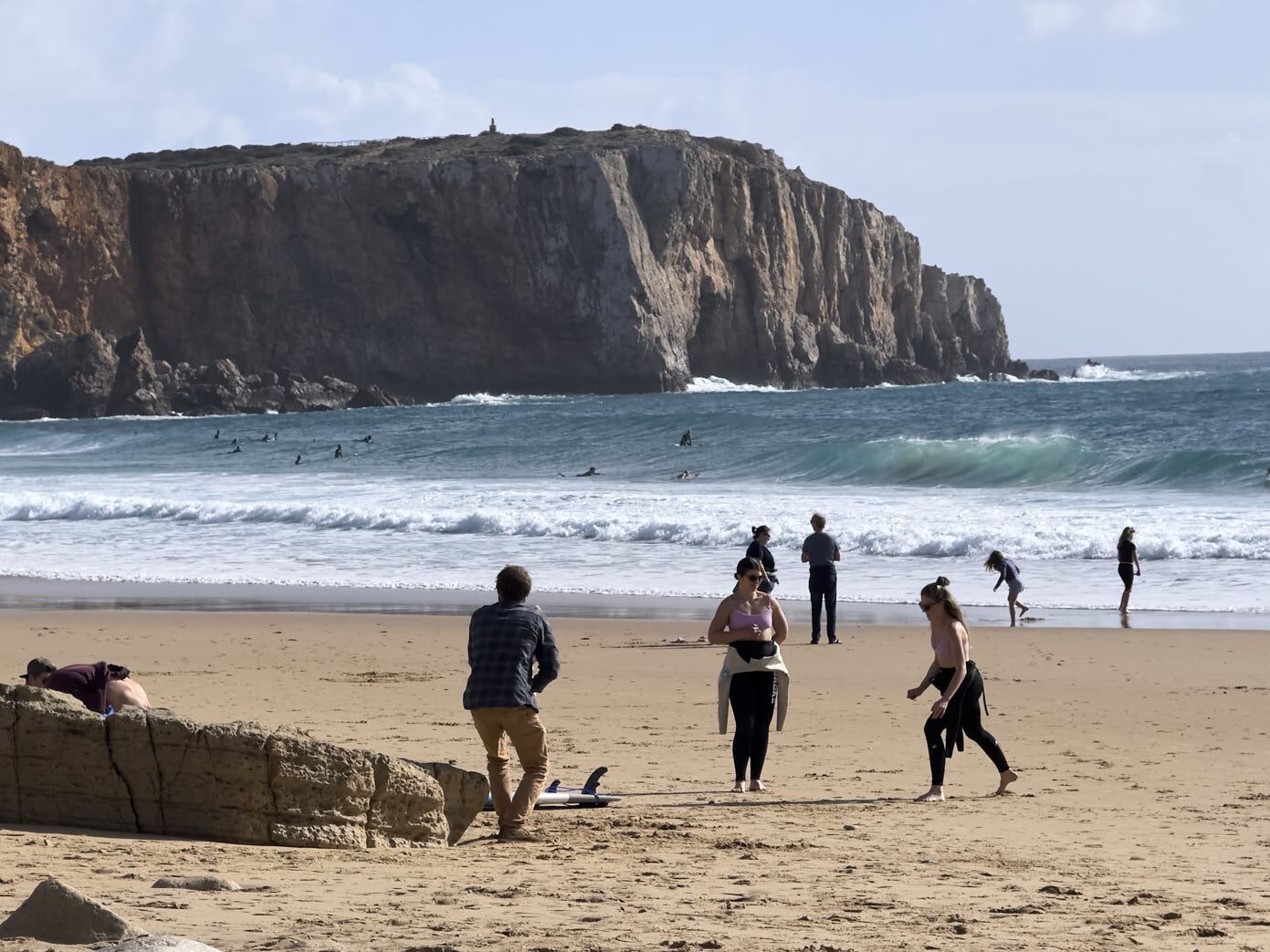
Sagres
The end of Europe: wind, cliffs, surf schools and a thin winter at the Algarve's south-western tip.
Updated 14 September 2026
The short version
- A village on the south-western corner of Europe, an hour and twenty from Faro airport and three hours from Lisbon, with a south coast and a west coast a few hundred metres apart.
- Suits surfers, divers, walkers and remote workers who want emptiness and do not mind wind. Does not suit families needing schools, anyone who needs a hospital nearby, or anyone who wants a town.
- Asking prices around €3.500 per square metre; a two-bedroom flat rents for about €1.100 a month, a house for about €1.700.
- Vila do Bispo council: IMI 0,30%, no tourist tax, no limits on new short-let registrations.
- The one thing everybody says: the wind. It blows here almost every day, and the reason people stay is that the two coasts face opposite ways, so one of them is always clean.
The village
What it is like to live there
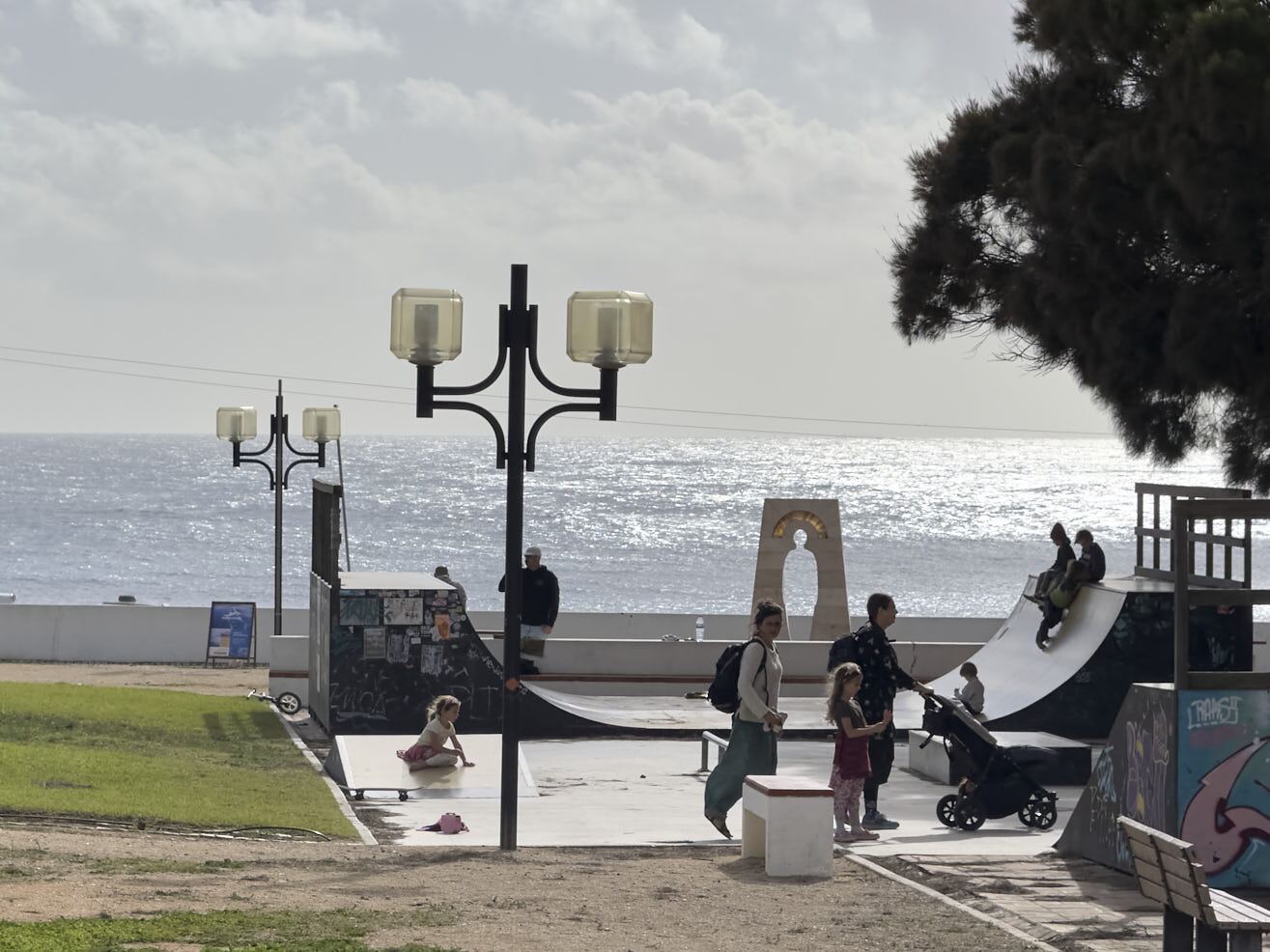
Sagres is about three streets, a fishing harbour, a fortress on a promontory and the cape beyond it where the land stops. Prince Henry sent the caravels from here and for a long time Europeans thought this was the edge of the world, which on a February evening with the spray coming over the cliff is an easy thing to believe. Fewer than two thousand people live in the village; the municipality's administrative town, Vila do Bispo, is ten minutes inland and is where the council, the vet and the cheaper houses are.
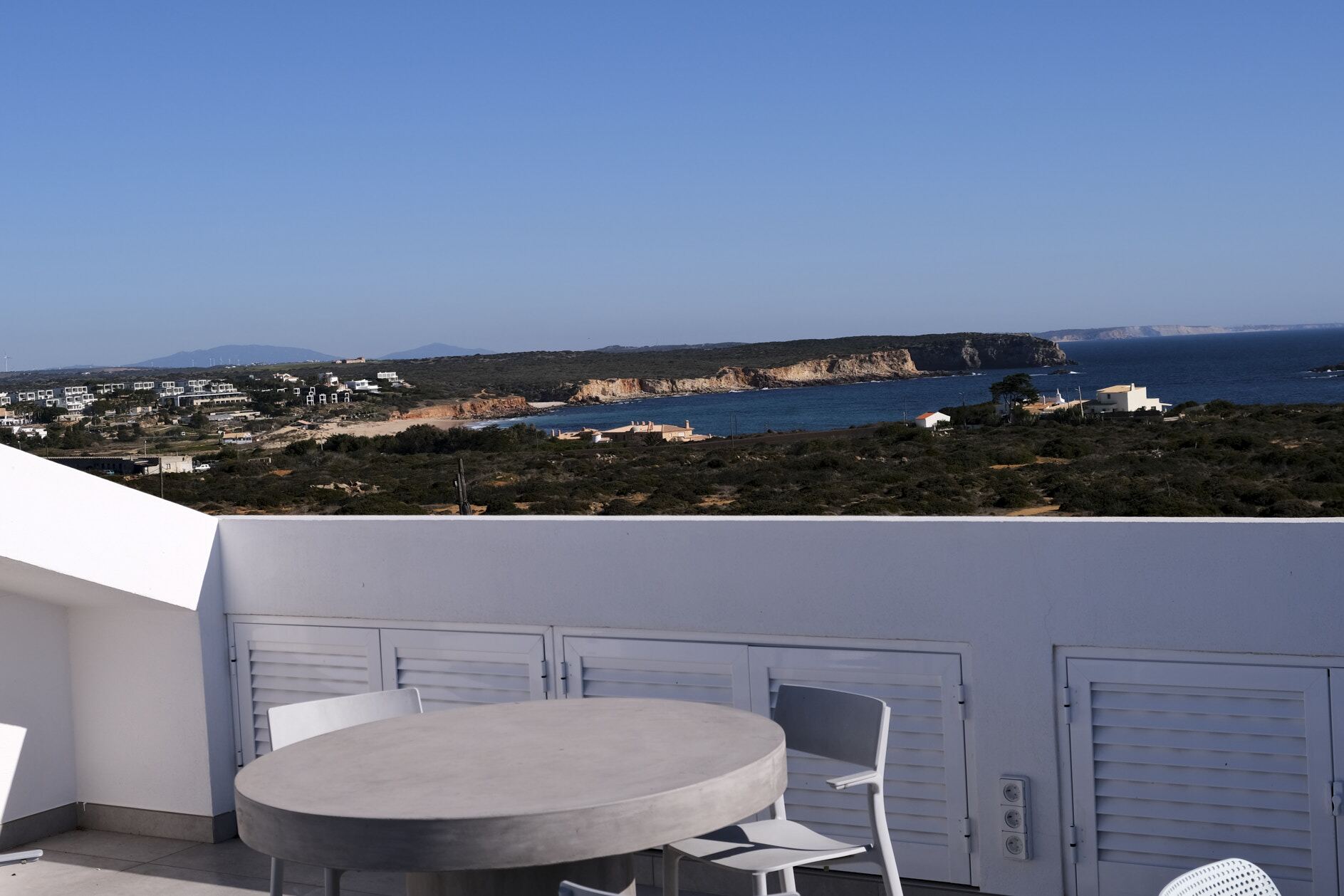
The geography is the whole story. The village sits on a promontory with a south-facing coast on one side and a west-facing coast on the other, a few hundred metres apart. Whatever the wind is doing, one of them is sheltered, which is why surfers, divers and fishermen have all put up with this place for centuries. It is also why the weather here is nothing like the Algarve an hour east: this is the Atlantic corner, windy, clear and cold.
The community is a small, strongly mixed one: Portuguese fishing families, a long-settled German and Dutch surf and diving crowd, and a newer layer of remote workers who came for the emptiness. Everyone knows everyone, which is either the attraction or the objection. Half the businesses close between December and February, and the people still here in January are the ones who actually live here.
Tips and tidbits
The short list of what you learn in the first month.
- Learn the two coasts. The summer northerly blows offshore on the south side and straight into the west side, so Mareta, Beliche and Zavial are clean while Cordoama and Bordeira are blown out. A southerly reverses it. Get this and you can be in the water every day.
- The wind does not really stop. It is not a summer nuisance here, it is the climate, and it is the main reason people leave again.
- Everything real is a drive. Lagos is thirty-five minutes for the hospital, the big shop, the secondary school and anything you would call a shop. Portimão is over an hour for the emergency department.
- The health post in the village is part-time. The nearest proper clinic is at Praia da Luz, half an hour, and the nearest emergency department is Portimão.
- There is no secondary school here. Children go on to Lagos, which is an hour of bus a day.
- Half the village shuts from December to February, including one of the two good dinner restaurants, which closes outright for part of the winter.
- July and August are a crush of vans and day-trippers on three streets. It is worth seeing that once before you decide, and worth seeing January too.
- Vila do Bispo, ten minutes inland, is cheaper, sheltered from the worst of the wind and much more Portuguese. If you do not need to see the sea from the kitchen, look there.
- The autumn bird migration funnels over the cape and is a genuinely world-class spectacle. The festival in October is the year's biggest gathering.
- The water is cold and clear, which is why the diving is the best in mainland Portugal and why you will own a good wetsuit within a month.
Getting there and getting around
Faro airport is about 110 kilometres and an hour and twenty minutes on the N125 and the A22; Lisbon is 270 kilometres and roughly three hours. Lagos, the nearest real town, is thirty-five minutes. Buses run between Lagos and Sagres and there is a long coach to Lisbon, but the timetables are thin and built around the school and the season.
A car is not optional. Without one you are limited to the village and a slow bus, and the whole point of living here, the two coasts and the beaches strung between them, needs one. Fuel is at the supermarket in the village, and everything else is at Lagos.
Honest downsides
The wind, first, and it is not a small thing: it blows most days of the year and it wears some people down within a winter. Then the isolation: everything that is not surfing, eating or walking is thirty-five minutes away at Lagos, and the emergency department is over an hour. Half the village closes from December to February and the social life shrinks to a handful of rooms. In July and August the same three streets are a crush of campervans and day-trippers. There is no secondary school, no hospital, no cinema and not much of a high street. And the whole place amounts to three streets, which you should stand in and look at honestly before you decide it is romantic.
Living in Sagres
Residence and paperwork
There are two routes in. An EU citizen needs no visa: you arrive, and after three months you register as a resident at the council in Vila do Bispo with a passport and proof of an address. Everyone else applies at a Portuguese consulate before travelling, most often for the D7, for people living on a pension or other income that arrives whether they work or not, or the D8, the digital-nomad visa, for remote workers who can show earnings of about four times the Portuguese minimum wage. Either becomes a residence permit once you are here, issued by AIMA, whose appointments are the slow part of the whole business and the reason people start a year ahead.
The order that saves the most time: the tax number, the NIF, first, because a bank account, a lease, a phone contract and the electricity all ask for it; then a Portuguese bank account; then the rental contract, which is what proves the address; then the residence registration, and only then the health centre. A lawyer to run the appointments costs a few hundred euros and is worth it for a first move from outside the EU.
- Portuguese visas: the foreign ministry's portal, where the D7 and D8 conditions and the consulate appointments live.
- AIMA: the agency that issues and renews the residence permit once you are in the country.
Housing
Three places, ten minutes apart, and they are not alike. Sagres itself is low-rise village houses from the seventies to the nineties, holiday flats, and newer building out towards Martinhal; it has the sea, the surf and the seasonality. Vila do Bispo inland is the working administrative town: cheaper, more Portuguese, sheltered from the worst of the wind, and with no sea view at all. Salema, twenty minutes east, is a small whitewashed fishing village now largely holiday lets and northern European second homes, and the most expensive per square metre of the three.
Asking prices average around €3.500 per square metre across the municipality, which is more than the Silver Coast because there is so little stock and the park restricts new building. Rents run about €1.100 a month for a two-bedroom flat, €1.700 for a house and €2.800 for a villa with a pool, and long lets are genuinely scarce because the summer pays so much better. Arriving in October and taking something for the winter is the usual way in, and it also shows you the village at its emptiest, which is the honest test.
- Sagres village: the sea, the surf, the harbour, the seasonality, and holiday flats among the houses.
- Vila do Bispo: ten minutes inland, the council and the services, sheltered, cheaper and much more Portuguese.
- Salema and Budens: east along the south coast, whitewashed and pretty, dominated by second homes, the priciest per square metre.
- Raposeira and the inland hamlets: the cheapest of all, farmland, and five minutes from both coasts.
- Idealista: the portal most listings reach first, in English, though stock here is thin and moves slowly.
- Imovirtual: the second portal, worth a look because some agents post to one and not the other.
- Casa Sapo: the older Portuguese portal, and often the first with a village house inland.
Cost of living
For one person renting a two-bedroom flat, a comfortable month runs about €1.800 to €2.200. A family of four in a house sits nearer €3.200 to €4.000 without school fees. Fish is cheap and the restaurants are not expensive, but everything that arrives by lorry costs a little more than it does an hour east, and the car is a permanent line rather than a convenience. The rents in the table come from the market data and move with it; the rest is what the village charged when the guide was last updated.
| What things cost | |
|---|---|
| Rent, a two-bedroom flat, unfurnished | €1.100 a month |
| Rent, a house | €1.700 a month |
| Rent, a villa with a pool | €2.800 a month |
| A coffee at the counter | €0,80 to €1,30 |
| The lunch plate, with bread and a drink | €12 to €18 |
| Dinner for one, fish and wine | €25 to €45 |
| A beer on a terrace | €2,50 to €4 |
| Groceries for one, a month | €280 to €380 |
| Electricity, water, gas and internet, a month | about €105 |
| A boat dive with a centre | €65 to €75 |
| A seabird trip from the harbour | €52, or €38 for the dolphins |
| Diesel for the Lagos run, a month | €60 to €100 |
Health
Public
The national health service, the SNS, covers anyone resident, and you register through the health centre at Vila do Bispo, of which the post in Sagres village is a part-time extension. That post is a nurse and a doctor on limited hours, not a clinic. The emergency department that serves this corner is at Portimão, a little over an hour away, with the region's main hospital at Faro an hour and a half. In a genuine emergency that distance is the fact that matters, and it is the strongest argument against living here for anyone older or with a condition that flares.
- Extensão de Saúde de Sagres: the village health post on Rua Joaquim Maurício, part of the Vila do Bispo centre, part-time hours.
- Hospital de Portimão: the 24-hour emergency department for this corner of the Algarve, a little over an hour away.
Private
Private care means Praia da Luz, half an hour east, where a long-established clinic serves the whole foreign community of the western Algarve, or Lagos. A consultation runs €60 to €100 and insurance is priced by age and plan, from about €30 a month at thirty to over €100 at sixty, with a co-payment on each visit. Most residents here carry it, precisely because of the distances.
- Family Medical Centre, Praia da Luz: the nearest private clinic, half an hour east, used by the western Algarve's foreign community.
Shopping
Markets
The village market opens from eight most mornings and is closed on Sundays: fish off the harbour and a few vegetable stalls. It is small, and it is the only market in the municipality worth the walk.
- Mercado 25 de Abril: the village market, fish and vegetables from eight in the morning, closed Sundays.
Shops
The shops are a pharmacy, a hardware shop, three or four surf shops and the fishing chandlers, and that is the whole of it. Anything else, from a pair of shoes to a washing machine, means Lagos. People here keep a running list and do the Lagos trip fortnightly rather than making it twice.
Supermarkets
One supermarket in Sagres, an Intermarché with its own fuel station, and a Lidl ten minutes inland at Vila do Bispo. Between them they cover the week. The proper big shop, with the choice and the prices, is Lagos, thirty-five minutes each way.
- Intermarché Sagres: the only supermarket in the village, with its own fuel station.
- Lidl Vila do Bispo: ten minutes inland on the N268, where most of the weekly shopping actually happens.
Schools
The state grouping runs kindergarten and primary in Sagres village itself, which is a genuine advantage for small children: a two-minute walk, a handful in each year, and Portuguese picked up within a school year. From year ten there is nothing here and children travel to Lagos, an hour of bus a day.
For English-medium schooling the nearest is at Praia da Luz, about half an hour, taking children from five to eighteen through to A-levels; there is a second in Aljezur, three quarters of an hour north, for eleven to eighteen. Fees at both run roughly €7.000 to €12.000 a year, a fraction of Lisbon's, but the daily drive is real and in winter it is done in the dark at both ends.
- Agrupamento de Escolas de Vila do Bispo: the state grouping, with kindergarten and primary in Sagres village itself.
- Vale Verde International School: at Praia da Luz, half an hour east, English-medium from five to eighteen with IGCSEs and A-levels.
- Aljezur International School: three quarters of an hour north, English-medium for eleven to eighteen, about €7.200 to €8.100 a year.
Coworking spaces
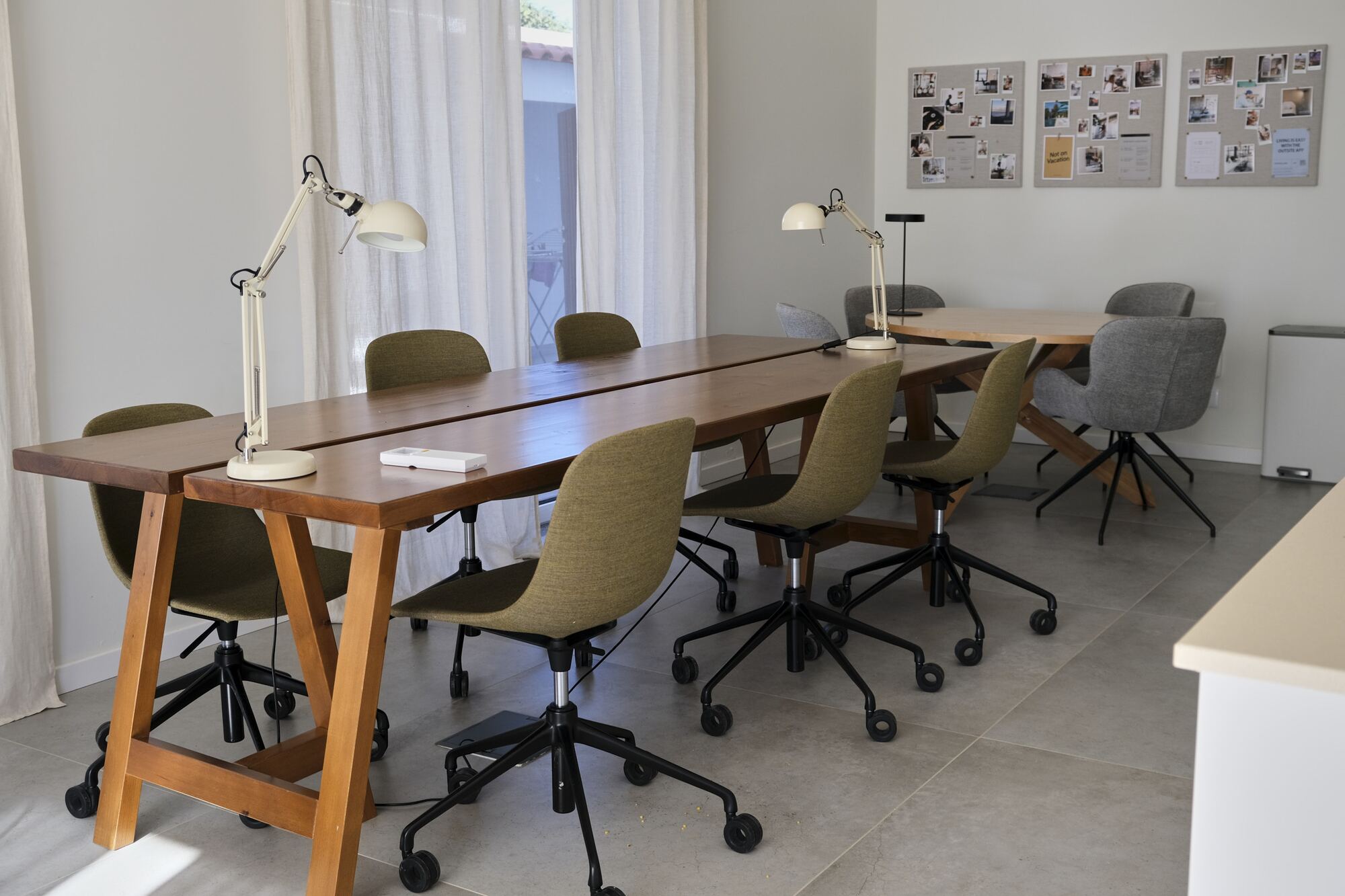
For a village this size, surprisingly, three places to work: an independent space with real desks on Rua das Cercas that takes day guests, and two surf colivings that rent desks and rooms together, one of them open through the winter with weeks from about €310. Nobody publishes a straightforward monthly desk rate, so ask. Connection in the village is fine; a house out in the hamlets may be on 4G, so test it on the viewing rather than after the lease.
- OFF THE HOOK: the independent space on Rua das Cercas, real desks, day guests from nine to six.
- LemonTree Eco Surfhouse: coliving with desks, open year-round, with winter weeks from about €310.
- Local Guesthouse: a small social workspace with private desks and a backup connection, guests first.
Community
Small, mixed and unavoidable. The Portuguese village runs on the harbour, the church and the football; the foreign half runs on surf, diving and yoga. They overlap in the supermarket and in the one late bar, which is more overlap than most of the Algarve manages. There is no need for a meetup app here: within a month of arriving you will know most faces, and within two you will know which of them you want to see again.
The yoga and sauna house in the village doubles as a market and concert space and is the easiest door for a newcomer. The birdwatching festival in October brings in the naturalists, and the trail association takes members and volunteers. For anyone who wants to be useful, the local charity runs care homes in Sagres and Budens and has an open volunteering page.
- Mandala Sagres: yoga, a sauna, markets and concerts in the village, with an introductory bundle for two classes.
- Sagres Birdwatching Festival: in October with the council and the bird society, and the year's biggest gathering.
- Rota Vicentina: the trail association, with open membership and a volunteering programme.
- Santa Casa da Misericórdia de Vila do Bispo: the local charity, with care homes at Sagres and Budens and an open volunteering page.
Taxes
On the home
Buying costs about seven percent on top of the price: the transfer tax, IMT, on a sliding scale that reaches 7,5% for a main home, stamp duty of 0,8%, and the notary and registry. Since May 2026 a buyer who is not resident in Portugal pays 7,5% on the whole price instead: a resident meets that rate only on the slice above about a million euros, so on a €500.000 home the non-resident pays roughly twice the tax. Then every year the council's property tax, IMI, at Vila do Bispo's rate of 0,30% of the tax office's valuation, which usually sits well below the market price. A first home can be exempt from IMI for three years.
On your income
You become tax resident after 183 days in a year, or sooner with a home you keep as your habitual one, and then pay two things on what you earn. Income tax, IRS, on worldwide income at progressive rates from 12,5% to 48%, with a 2,5% solidarity charge above €80.000. And social security: an employee pays 11% of gross and the employer 23,75% on top; a freelancer on recibos verdes pays 21,4% on 70% of what was invoiced, declared quarterly, with the first year exempt, and a remote worker paid by a foreign employer is normally treated as one. Contributions buy the state pension, sick pay and parental leave, not the health service, which comes with residence; EU citizens can stay on their home system for a while on an A1 certificate, and foreign pensions carry no contributions but are taxed at the normal rates. The old non-habitual resident regime closed to newcomers in 2024; its successor, IFICI, gives a flat 20% income tax for ten years to people in listed scientific, technical and start-up roles, applied for in the first year. Before any of it comes the tax number, the NIF, a morning at the tax office or a lawyer's fee from abroad.
What that means for a freelancer invoicing €100.000 a year, taxed on 75% of it under the simplified regime, with and without IFICI. An accountant costs €100 to €200 a month and, at these sums, earns it.
| A freelancer's year | Standard | Under IFICI |
|---|---|---|
| Invoiced | €100.000 | €100.000 |
| Social security, 21,4% of 70% of it | − €15.000 | − €15.000 |
| Income tax on 75% of it, progressive or flat 20% | − €25.000 | − €15.000 |
| Left | about €60.000 | about €70.000 |
A rough calculation on the 2026 tables, before the deductions for children, rent and health, rounded to the thousand. Not tax advice: the rules move with every budget, so check the date at the top of the guide.
- Portal das Finanças: the tax authority's portal, where the NIF, the IMI bills and the yearly return all live; in Portuguese, with an accountant's help worth its fee in the first year.
On a short let
Renting out by the night is business income, declared under category B, with a simplified regime that taxes a fraction of the gross for smaller operators, and no tourist tax, which not every council can say. The registration, the AL, is open in Vila do Bispo without a cap, which is not true of Lisbon or Porto. A long let is taxed at a flat 25% on the rent, less for contracts of five years or more.
Eating and drinking
Breakfast
Better than a village of two thousand has any right to be, because the surf trade brought it: sourdough, bagels and proper flat whites at one place, a specialty roaster with brunch until late at another, and a main-street café that everybody uses. Winter hours shorten and at least one of them will be closed on the day you want it, which is the pattern for everything here.
- Picnic: sourdough, bagels and the village's serious coffee, though the winter hours move.
- Sagres Surf & Coffee: specialty coffee and brunch from half past nine to half past ten at night, and open all year.
- The Hangout: the main-street café and restaurant the village actually uses.
Lunch
Fish, and you are standing beside where it landed. A plate runs €12 to €18 at the family grills, and the harbour place lets you pick from the counter, which costs more and is worth it. The one dish to understand here is percebes, the gooseneck barnacles picked off these cliffs by men on ropes, which explains both the price and the reverence. Inland at Vila do Bispo the cultural centre café is the cheap, excellent, entirely Portuguese option.
- A Tasca: at the harbour, pick your fish from the counter, €25 to €45.
- Adega dos Arcos: a family charcoal grill, nine to three, €15 to €25, closed Sunday and Monday.
- Solar do Perceve: gooseneck barnacles and grilled fish on the main street, €15 to €30.
- O Cultural: the cultural centre café at Vila do Bispo, cheap and very well liked.
Dinner
Two proper dinner restaurants and a handful of good rooms beyond them, which for a village this size is plenty and in February is more than enough. The cataplana at the fishermen's place is what residents book; the sit-down restaurant that has been going since 1995 opens only in the evening and closes outright for part of the winter. The incomers' canteen bakes its own bread and puts on live music, and twenty minutes east at Salema there is a fish institution with a queue.
- Retiro do Pescador: cataplana and grilled fish, the one residents book, €20 to €40, closed Mondays.
- Vila Velha: the village's sit-down restaurant since 1995, dinner only from half past six, and shut for part of the winter.
- Three Little Birds: bakes its own bread, live music, €15 to €20, the incomers' canteen, closed midweek.
- O Lourenço: Salema's fish institution twenty minutes east, €25 to €50.
Sundowners
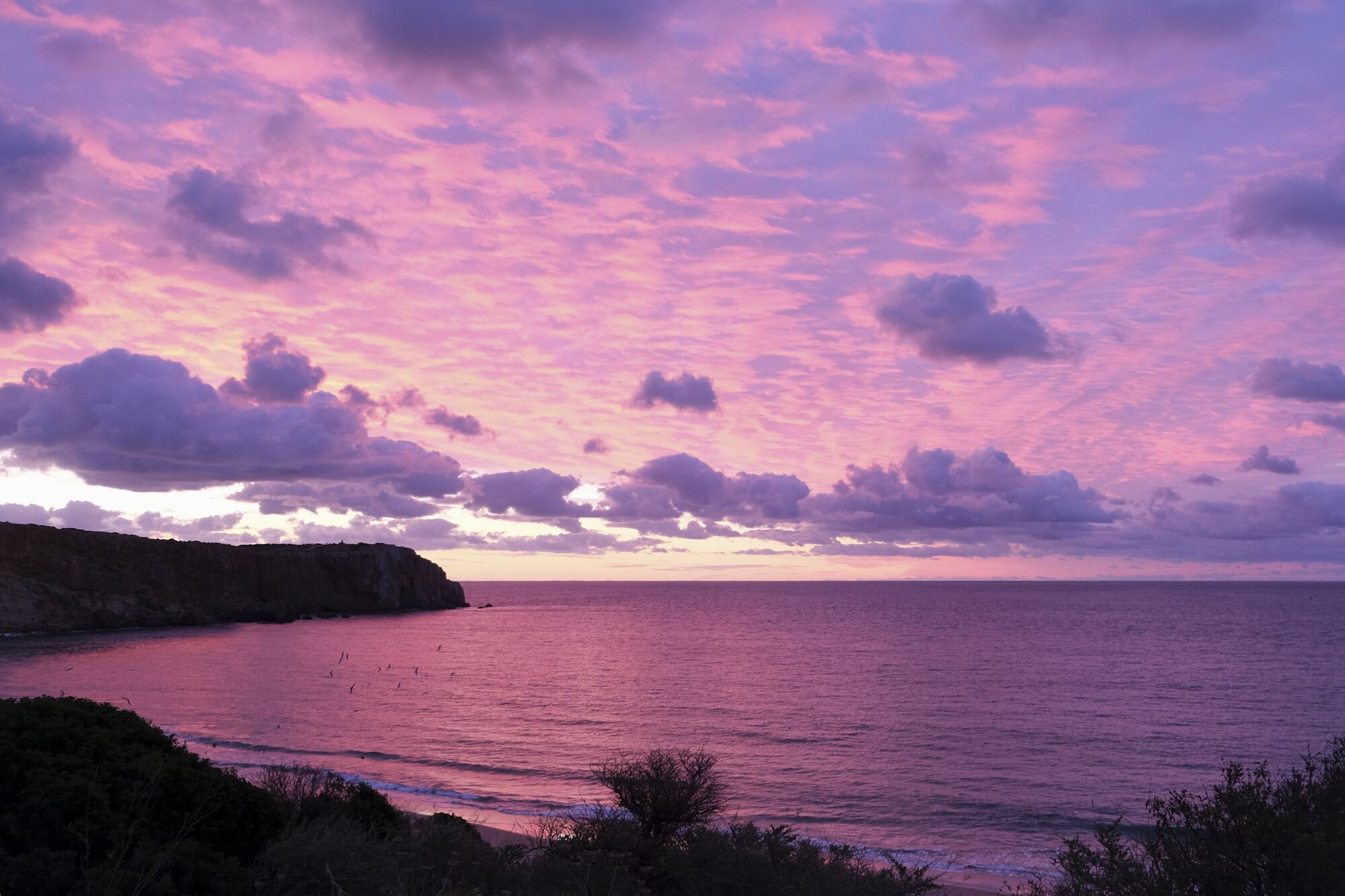
Sagres is famous for this and the fame is deserved: you are on the south-western corner of Europe with nothing to the west, and the sun goes into the Atlantic in front of the fortress. Half the village walks out to the cape or to Tonel for it. In the village itself there is a rooftop that everybody means when they say the rooftop, open until two, and a small wine bar for anyone who would rather sit down and be quiet about it.
- Pau de Pita: the rooftop everyone means, open until two, €10 to €15.
- Tide & Tannin: a small wine bar from half past five, the grown-up option, closed Mondays.
Nightlife
One real late bar, going since 1985, open until two and pouring proper cocktails, plus the gig nights at the bread-baking place and whatever the surf camps are doing in August. That is the honest list. In winter it thins further. Anyone for whom this matters should take that seriously rather than assume it will be fine, because there is no train home and Lagos is thirty-five minutes of dark road.
- Dromedário: the village's one real late bar, cocktails since 1985, open until two.
Activities
Beaches
The point of Sagres is that it has two coasts. The south-facing beaches sit in the lee of the promontory, sheltered from the prevailing northerly, warmer and calmer, and are where you swim. The west-facing beaches take the full Atlantic, are wild, cold and rip-prone, and are where you go when the wind swings. They are minutes apart, and learning which is which in which wind is the local skill.
- Mareta: the village's own beach, south-facing and sheltered, gentle water, and a two-minute walk from the main street.
- Beliche: south-west between high cliffs on the way to the cape, the prettiest of them, with a stair down and a beach bar in season.
- Zavial and Salema: east along the south coast, calmer still, family water, and a right point at Zavial for the experienced.
- Tonel: over the headland and west-facing, punchy and exposed, with the fortress above it and the best sunset on the peninsula.
- Castelejo and Cordoama: north up the west coast, wild, vast, strong currents and almost nobody on them.
- Bordeira at Carrapateira: half an hour north, a huge beach and dune system, and mellow at the river mouth.
Surf
The reason many people are here, and the mechanism is worth understanding before anything else. The prevailing summer northerly blows offshore on the south coast and straight onshore on the west coast, so on a typical windy day Mareta, Beliche and Zavial are clean and groomed while Cordoama and Bordeira are a mess; a southerly turns that round exactly. Two coasts, one of them always working, which is why the schools here drive you somewhere different each morning rather than teaching on a fixed beach.
Mareta is where you learn, sheltered and gentle in the middle of the village. Beliche is the all-levels favourite. Tonel over the headland is punchy and for intermediates upward, Zavial is a right point for people who can already surf, and Castelejo and Cordoama up the west coast are exposed and have currents that catch people out. Water runs fifteen to eighteen degrees, so a full suit for most of the year, and the swell is best from autumn to spring.
- Wavesensations: year-round lessons, picking the beach each morning by the wind, which is the local method.
- Sagres Natura Surf Camp: drives you to whichever coast is working, with good spot-by-spot notes on its site.
- Freeride Surf School: at the Memmo Baleeira, small and very well reviewed.
Diving and the boats
The best diving in mainland Portugal, and the reason is the same cold clear Atlantic water that makes the swimming brisk: reefs, tunnels and caves around the cape, a set of wrecks, and visibility that the south coast cannot match. A boat dive runs €65 to €75 with the centre at the harbour, and it is a year-round activity rather than a summer one.
The other thing the harbour does is take you out to look. The cape is one of the great seabird funnels in Europe and there are boats with marine biologists aboard for shearwaters and gannets, and shorter trips for the dolphins that work this corner all year. In October the autumn raptor migration piles up over the promontory, and the festival that has grown around it is the biggest nature event in Portugal.
- Divers Cape: the PADI centre at Baleeira harbour: the reefs, the tunnels, the caves and the wrecks, €65 to €75 a boat dive.
- Cape Cruiser: seabird trips with a biologist aboard at €52, and dolphin trips at €38, from the harbour.
Walking
Two of the great routes of the Rota Vicentina run through this municipality: the Fishermen's Trail along the very edge of the cliffs, which is one of the finest coastal walks in Europe, and the Historical Way inland through the villages. From the village itself you can walk out to the cape, round the promontory under the fortress, or north up the west coast towards Castelejo on a path with nothing on it at all.
Autumn to spring is the season, because there is no shade anywhere and the summer sun on white rock is brutal. On a clear February morning with the flowers out and the whole cliff to yourself, this is the best walking in the south of Europe, and it is free.
- Rota Vicentina: the Fishermen's Trail along the cliffs and the Historical Way inland, both running through the municipality.
In the village
The fortress on the promontory, where the navigation school is said to have been and where the great compass rose is set into the ground, carries a European Heritage Label and is the one monument here; the lighthouse at Cabo de São Vicente beyond it is the south-westernmost point of the continent and the sunset gathering every evening. Beyond those: the harbour at Baleeira when the boats come in, the market, and the October festival. There is no cinema, no theatre and no gallery, and the nearest of each is Lagos.
- Fortaleza de Sagres: the fortress on the promontory with the compass rose, carrying a European Heritage Label.
Visiting
36 hours in Sagres
In the manner of the New York Times column: arrive Friday afternoon, leave Sunday, and use the weekend to test the village before you decide. Every stop is chosen to answer a question a future resident has, not a visitor.
Come in February if you are serious. The swell is good, the cliffs are green and full of flowers, and you will see exactly how much is shut, which is the thing an August visit hides completely.
Friday
- 5 pm The cape at sunset. Drive out past the fortress to Cabo de São Vicente, the south-westernmost point of Europe, and stand there with everybody else as the sun goes into the Atlantic. Then walk back along the cliff. It is the thing that sells the place, and it is worth getting out of the way first.
- 8 pm Retiro do Pescador. The cataplana at the fishermen's place, which is the one residents book, €20 to €40. Closed Mondays, and worth calling ahead in any season.
- 10.30 pm Dromedário. The village's one late bar, cocktails since 1985, open until two. This is the whole of the nightlife, so judge it now rather than later.
Saturday
- 8.30 am Picnic, and a look at the wind. Coffee and sourdough, then check the forecast and decide which coast is working. Getting this right is the single most useful local skill, and today is the day to practise it.
- 10 am The coast that is working. A lesson or a swim, at Mareta and Beliche if the wind is from the north, at Castelejo and Cordoama if it has swung south. The schools here pick the beach each morning, and going with them is the fastest way to learn the system.
- 1 pm Solar do Perceve. Percebes on the main street, the gooseneck barnacles picked off these cliffs by men on ropes. €15 to €30, and the one dish that explains this coast.
- 3 pm The other coast. Drive to whichever side you did not surf, then north to Castelejo and Cordoama on the west. Twenty minutes apart, completely different water, and the whole geographic argument for living here in one afternoon.
- 6.30 pm Tonel, or the rooftop. The sunset from the beach under the fortress, or from the rooftop in the village if the wind has won. Both are the same sun and the second has a chair.
- 9 pm Three Little Birds. The incomers' canteen, its own bread, €15 to €20, and live music on the right night. Look around the room: these are the foreign residents, and this is most of them.
Sunday
- 9 am The Fishermen's Trail. An hour north along the cliff top from the village and back, on the edge of the continent with nothing built on it. This is the thing that makes people stay, and an hour will tell you whether it works on you.
- 11.30 am Vila do Bispo. Ten minutes inland to the working town: the council, the Lidl, the school, and houses at two thirds the price with no sea view. Coffee at the cultural centre café. If you would live here rather than in the village, the whole arithmetic changes.
- 1.30 pm Salema, and the road. Twenty minutes east to the whitewashed fishing village for lunch, and a look at the third housing option. Then the N125 and the A22 to Faro, an hour and twenty, and the question of whether the wind was the price or the point.
Explore the surroundings
Sagres is at the end of the road, which means everything is in one direction. The first is the town you will use weekly; the rest are days out.
- Lagos: thirty-five minutes east, the town you will actually use: the hospital, the shops, the schools and the marina.
- Carrapateira and the Bordeira dunes: half an hour north, the biggest dune system on the coast and the boardwalk across it.
- Aljezur: three quarters of an hour north, the castle town and the empty beaches of the Costa Vicentina.
- Monchique: an hour and a quarter north-east, the hills behind the Algarve, cork oaks and hot springs.
- The eastern Algarve: an hour and a half east, the lagoons and islands of the Ria Formosa, and warm shallow water.
- Faro: an hour and twenty, the airport, the region's main hospital and the only city in the south.
Hotel recommendations
Two, and they are both good. One over the harbour in the village, which puts you in walking distance of everything Sagres has; one out on the promontory with the fortress and the cape in front of it, which is the view people come for.
- Memmo Baleeira: the design hotel over the harbour, a walk from the village, with a surf school attached.
- Pousada de Sagres: out at Ponta da Atalaia, with the fortress and the cape in view.
Sources
Sold pricesexactmunicipalINE, Estatísticas de preços da habitação ao nível local, indicator 0012234: the median deed price per square metre of every home sold in the trailing twelve months, by municipality and parish, refreshed from INE's API each quarter. Deed prices, not asking prices.
IMI, tourist tax and containmentexactmunicipalIMI: Vila do Bispo council, 0,30% on urban property for 2026. No tourist tax (not among the seven Algarve councils charging one) and no containment areas.
Figures calibrated 2026-08.