Sintra
Hills, palaces and forest half an hour from Lisbon, a weekend destination with a cooler, wetter climate.
Updated 14 September 2026
The short version
- A palace town in a wooded hill range 25 km west of Lisbon, with a train to Rossio in about 40 minutes, the airport half an hour by car, and its own cold Atlantic coast twenty minutes down the other side.
- Suits people who want green, quiet and space within reach of a capital, and families using the international schools at Linhó. Does not suit anyone who wants sun and dry air: this is the wettest, greenest, mouldiest corner near Lisbon.
- Asking prices around €4.000 per square metre; a two-bedroom flat rents for about €1.500 a month, a house for about €2.600.
- Sintra council: IMI 0,30%, tourist tax €2 a night, no limits on new short-let registrations.
- The one thing everybody says: the damp. The serra makes its own weather, cloud sits on the hill for days, and a north-facing house needs a dehumidifier running all winter.
The town
What it is like to live there
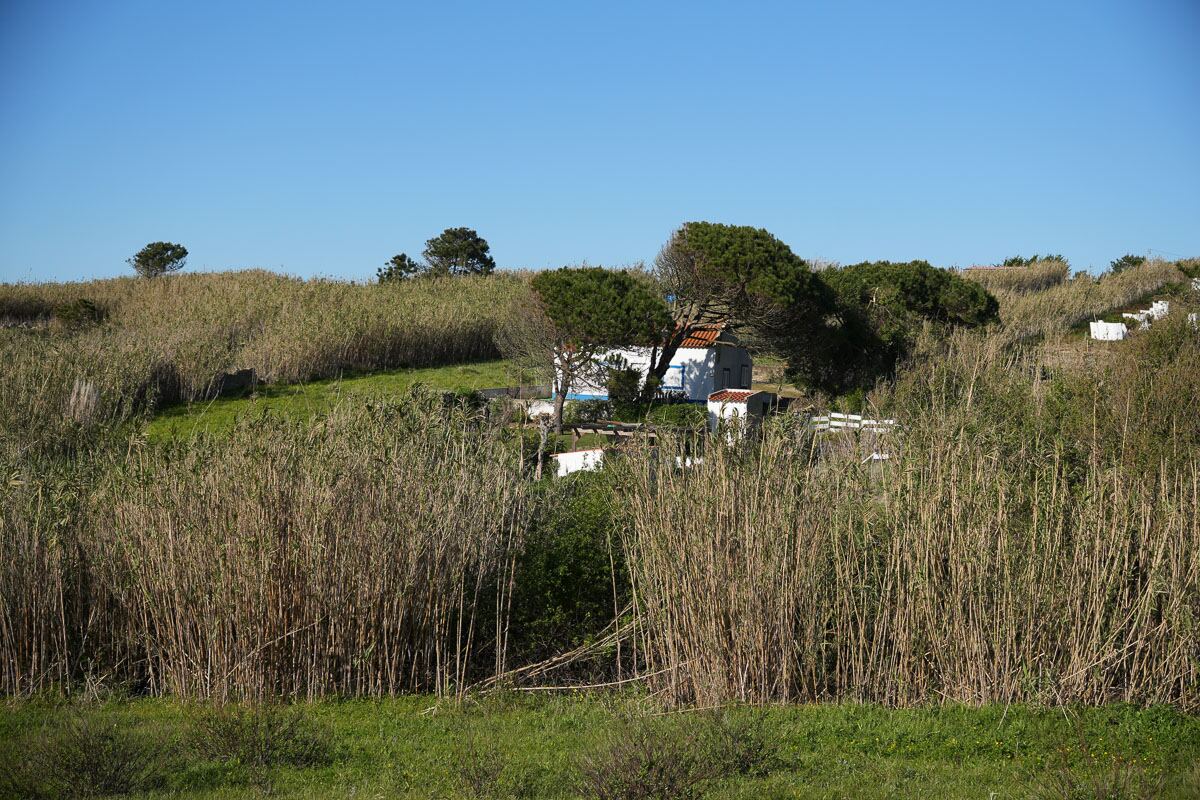
Sintra is a hill covered in forest with palaces on top of it, a small old town clinging to one side, and a string of villages and a wild coast on the other. Byron called it glorious Eden and the whole place has been living off that ever since: it is a world heritage site, it takes millions of visitors a year, and the town centre from spring to autumn belongs entirely to them. Residents live in São Pedro just up the road, in the villages behind the hill, or down on the coast, and treat the palace town as somewhere to take people.
The municipality is large and mixed, running from these villages down to the dense suburbs on the Lisbon train line, and the two have almost nothing to do with each other. The part this guide means is the serra and the coast: Colares, Almoçageme, Banzão, Praia das Maçãs, and the modern gated end at Linhó and Beloura where the international schools are. The foreign community here is smaller and quieter than Cascais's, and it skews to people who wanted trees.
The weather is the thing to understand. Winters run 8 to 15 degrees and summers 17 to 28, milder than Lisbon in both directions, but the serra makes its own climate: it is the wettest place near the capital, cloud sits on the hill for days at a time, and the summer north wind blows hard every afternoon on the coast. Houses go damp and mouldy without dehumidifiers, and a north-facing room on the hill can be genuinely unpleasant in February.
Tips and tidbits
The short list of what you learn in the first month.
- Do not live in the town centre unless you love tourists. From March to October the streets and the Pena road are jammed daily and parking is a war. São Pedro, five minutes up, is the same beauty without the coaches.
- The damp is real and it is the first thing to check on any viewing. Ask which way the rooms face, look behind the wardrobes, and budget for a dehumidifier in every bedroom.
- The train serves the town and the suburbs, not the villages or the coast. If your house is at Colares or Almoçageme you need a car, and probably two.
- Residents of Portugal get into the Parques de Sintra sites free on Sundays and holidays with ID. The annual pass is €90 and pays for itself in five visits, which is worth it if you will walk the parks weekly.
- The coast is twenty minutes over the hill and ten degrees colder in the wind. Praia Grande has the surf schools and a sea pool; Adraga is the pretty one; Ursa is a scramble and has no facilities at all.
- Colares wine is one of the oldest demarcated regions in Portugal, grown on ungrafted vines in sand. Almost nobody outside the area drinks it, which keeps it cheap where it is made.
- The municipal market in the town is open Tuesday to Sunday and holds the only specialty coffee for miles, plus a craft beer bar. The São Pedro fair, on the second and fourth Sunday, is the real one for produce and junk.
- Restaurants close a weekday, usually Monday or Wednesday, and the coast places shorten their hours from November. Check before driving over the hill.
- The new hospital at Algueirão-Mem Martins has a 24-hour emergency department, which is a recent and significant improvement; before it opened everything went to Amadora.
- Winter afternoons under the hill are dark by four. It is the single most common complaint from people who arrived in June.
Getting there and getting around
Trains run from Sintra to Rossio in the middle of Lisbon in about 40 minutes, every ten to twenty minutes through the day, with a second slower line to Oriente. Lisbon airport is 30 to 40 minutes by car on the A16 and IC19 outside the rush, closer to an hour in the morning. For the city itself, the train is easily the better option: the road in is one of the worst commutes in the country.
A car is not optional unless you live within walking distance of the station and never leave the town. The train does not serve Colares, Almoçageme or the coast, and the bus to Praia das Maçãs is thin in winter. The roads over the hill are narrow, wooded and beautiful, and full of coaches in high season.
Honest downsides
The tourist crush is the first thing a resident names: the centre and the Pena road are jammed every day from spring to autumn, parking is a fight, and the town's prices are set by visitors rather than by local wages. The second is the damp, and the mould and the dehumidifiers that come with it. The third is the winter dark under the hill, which surprises everyone who arrived in summer. Beyond those: public transport is poor once you leave the train line, the health centre queues are long, and the municipality's cheap end, the dense suburbs down the line, is a different world from the serra and is what most Portuguese mean when they say Sintra.
Living in Sintra
Residence and paperwork
There are two routes in. An EU citizen needs no visa: you arrive, and after three months you register as a resident at the council in Sintra with a passport and proof of an address. Everyone else applies at a Portuguese consulate before travelling, most often for the D7, for people living on a pension or other income that arrives whether they work or not, or the D8, the digital-nomad visa, for remote workers who can show earnings of about four times the Portuguese minimum wage. Either becomes a residence permit once you are here, issued by AIMA, whose appointments are the slow part of the whole business and the reason people start a year ahead.
The order that saves the most time: the tax number, the NIF, first, because a bank account, a lease, a phone contract and the electricity all ask for it; then a Portuguese bank account; then the rental contract, which is what proves the address; then the residence registration, and only then the health centre. A lawyer to run the appointments costs a few hundred euros and is worth it for a first move from outside the EU.
- Portuguese visas: the foreign ministry's portal, where the D7 and D8 conditions and the consulate appointments live.
- AIMA: the agency that issues and renews the residence permit once you are in the country.
Housing
Three or four markets, and they are genuinely different places. Sintra town and São Pedro are old stone houses and small flats, beautiful, damp, tourist-adjacent and expensive for what they are. The villages behind the hill, Colares, Almoçageme, Banzão and Mucifal, are quintas, village houses and newer villas with gardens: cheaper, quieter, and where residents actually live. The coast strip at Praia das Maçãs and Azenhas do Mar is flats and holiday houses, windy and half empty in winter. Linhó and Beloura are the modern gated end, closest to the schools and to Cascais, and priced accordingly.
Asking prices average around €4.000 per square metre across the municipality, well under Cascais and well over the Silver Coast. Rents run about €1.500 for a two-bedroom flat, €2.600 for a house and €4.500 for a villa with a pool. Whatever you look at, view it in winter if you can, or at least ask to see it on a wet day.
- Sintra town and São Pedro: old stone, damp, walkable, and the coaches outside from March.
- Colares, Almoçageme, Banzão and Mucifal: the villages behind the hill, quintas and gardens, the best value and the most ordinary life.
- Praia das Maçãs and Azenhas do Mar: the coast, flats and holiday houses, wind and winter quiet.
- Linhó and Beloura: modern, gated, next to the international schools and ten minutes from Cascais.
- Idealista: the portal most listings reach first, in English, and the only easy way to compare the hill against the villages.
- Imovirtual: the second portal, worth a look because some agents post to one and not the other.
- Casa Sapo: the older Portuguese portal, and often the first with a quinta that never reaches the others.
Cost of living
For one person renting a two-bedroom flat, a comfortable month runs about €2.400 to €2.800. A family of four in a house sits nearer €4.400 to €5.200 without school fees, and roughly double that with two children at Linhó. Heating and dehumidifying cost more here than anywhere else on this site, which is a line people forget. The rents in the table come from the market data and move with it; the rest is what the area charged when the guide was last updated.
| What things cost | |
|---|---|
| Rent, a two-bedroom flat, unfurnished | €1.500 a month |
| Rent, a house | €2.600 a month |
| Rent, a villa with a pool | €4.500 a month |
| A coffee at the counter | €0,90 to €1,50 |
| The lunch plate, with bread and a drink | €10 to €14 |
| Dinner for one, fish and wine | €25 to €45 |
| A beer on a terrace | €2,50 to €4 |
| Groceries for one, a month | €300 to €400 |
| Electricity, water, gas and internet, a month | about €130 |
| A coworking desk, a month | €90 to €250 |
| An international school at Linhó, a year | €12.000 to €24.500 |
| The annual pass to the Sintra parks | €90, or €285 for a family |
| The monthly transport pass, all of the Lisbon region | €40 |
Health
Public
The national health service, the SNS, covers anyone resident: you register at the health centre in the town with your tax number and proof of address, get a user number, and are assigned a family doctor when one is free. Sintra's centres are among the busiest in the country and the queues show it. The emergency department was for years at Amadora, forty minutes away and famously overloaded; a new hospital at Algueirão-Mem Martins now takes emergencies within the municipality, which is the single biggest practical improvement here in a decade.
- Centro de Saúde de Sintra: the public health centre in the town, where you register for a family doctor.
- Hospital Fernando Fonseca and Hospital de Sintra: the public health service for the area, with the new 24-hour hospital at Algueirão-Mem Martins.
Private
Private care is used by most foreign residents for anything routine. A specialist consultation runs €60 to €100, the appointment comes within days, and the private hospital in town has a walk-in service from eight in the morning until ten at night for adults and children, which is what people use instead of the emergency room. Insurance is priced by age and plan rather than income, from about €35 a month at thirty to over €110 at sixty, with a co-payment on each visit and exclusions for what you already have.
- Hospital CUF Sintra: the private hospital, with walk-in care daily from 8 to 22 for adults and children.
Shopping
Markets
The municipal market on Rua do Paço is open Tuesday to Sunday and has become the best room in the town: the produce stalls, the only specialty coffee for miles and a craft beer bar under the same roof. The bigger event is the São Pedro fair on the second and fourth Sunday of the month, which fills the square with produce, cheese, plants and a great deal of junk, and is where the villages meet.
- Mercado Municipal de Sintra: on Rua do Paço, Tuesday to Sunday from 7 to 22, with the coffee bar and the craft beer inside it.
- Feira de São Pedro: the second and fourth Sunday of the month in Praça D. Fernando II: produce, cheese, plants and junk.
Shops
The town's shops sell tiles, cork and queijadas to visitors. For ordinary things, São Pedro and the villages have the hardware, the pharmacies and the tradespeople, and Cascais or the retail parks at Sintra Retail Park cover anything larger. Colares has a small high street that serves the whole coast side.
Supermarkets
The big weekly shop is the Continente at Lourel on the edge of the town, open daily to ten. Pingo Doce sits in the town itself for a top-up, and there is a smaller Continente at Colares for the coast side, which saves the drive over the hill.
- Continente Modelo Sintra: the big weekly shop at Lourel, daily 8 to 22.
- Continente Bom Dia Colares: the village shop on the coast side, daily 8 to 21, which saves the hill.
Schools
The state schools of the Monte da Lua grouping cover Sintra, São Pedro, Colares and Linhó, eleven schools from pre-school to secondary, free and taught in Portuguese. They are ordinary Portuguese state schools, which is to say variable and mostly fine, and children under about ten pick the language up within a school year.
The reason many foreign families are here at all is Linhó, where two of Portugal's largest international schools sit within a few minutes of each other, with American, IB and British programmes from age three to eighteen and fees between about €12.000 and €24.500 a year. A third, at Carcavelos, is twenty-five minutes away over the hill. That cluster is shared with Cascais, and choosing between the two towns often comes down to which side of the serra you would rather do the school run on.
- Agrupamento de Escolas Monte da Lua: the state grouping, eleven schools across Sintra, São Pedro, Colares and Linhó, free and in Portuguese.
- TASIS Portugal: at Linhó, ages three to seventeen, €13.000 to €24.300 a year with lunch included.
- Carlucci American International School: also at Linhó, an American diploma and the IB, €12.100 to €23.500 plus registration and a building fee.
- St. Julian's School: at Carcavelos, twenty-five minutes over the hill, British and IB, the largest of the three.
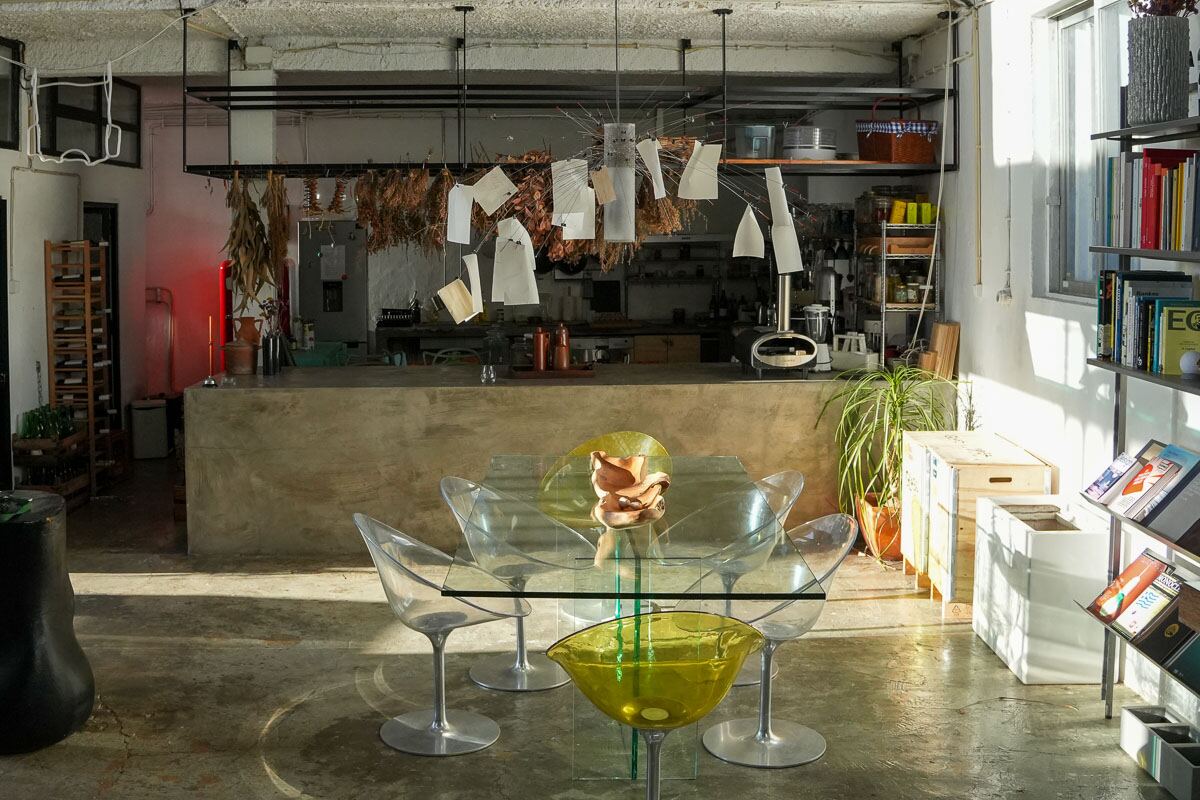
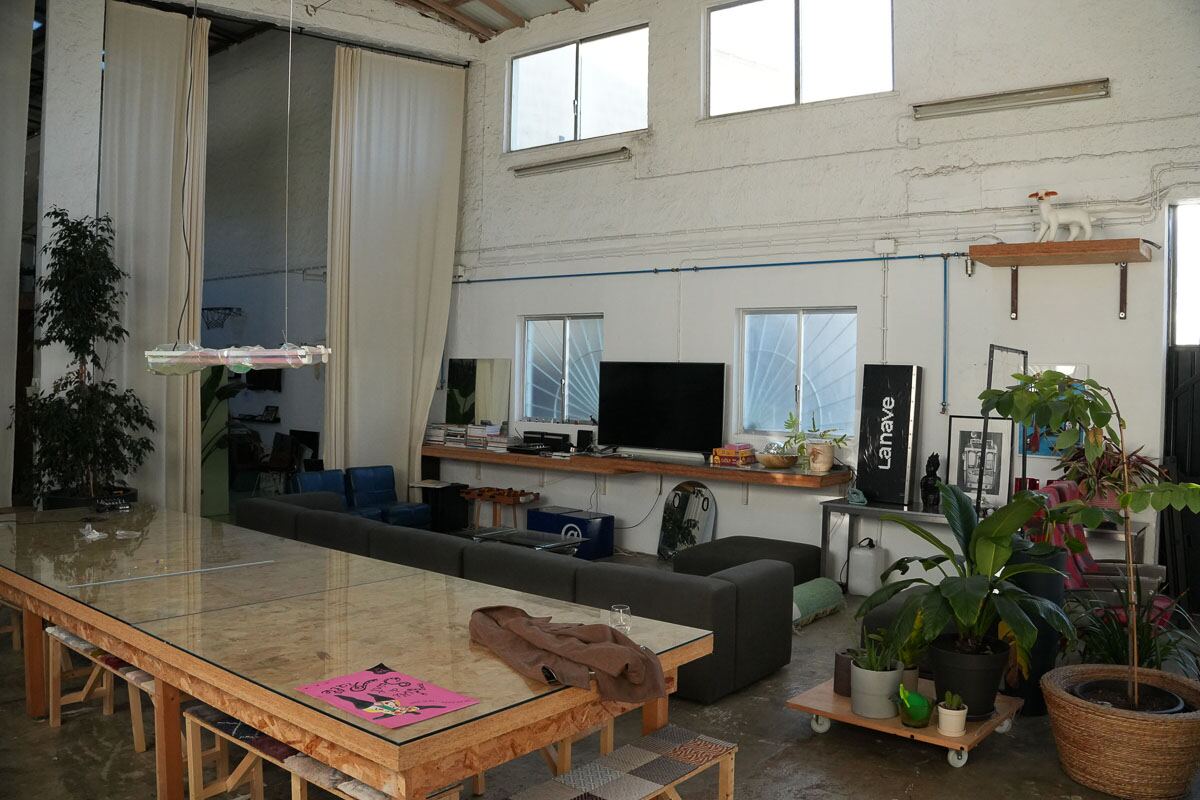
Coworking spaces
Thin, and much thinner than the population would suggest, because most remote workers here have a house with a room in it. There are four desks by the concert hall at €10 a day or €200 a month, a space with a kitchen and parking at São Pedro, and a larger commercial place out at Massamá twenty minutes away. Fibre reaches the town, the villages and the coast, but a quinta up a track may not have it, and the serra's weather takes lines down more often than the flat coast does. Test the connection on the viewing.
- iogo Cowork: four desks by the Olga Cadaval concert hall, €10 a day, €90 for ten days or €200 a month, weekdays only.
- Espaço Cowork & Lab: at São Pedro, open and private desks with a kitchen and parking nearby.
- AMA Cowork: at Massamá, twenty minutes out, an open desk from €200 a month or €40 a day.
Community
Quieter and more Portuguese than Cascais over the hill. The foreign community here is smaller, older in residence if not in years, and clusters either around the international schools at Linhó or in the villages, where it mixes more than it does on the coast. There is no nomad scene to speak of and no café where you will simply fall into conversation, so joining something is not optional.
The most Portuguese door, and the one people are most surprised by, is the volunteer fire brigade at Colares, which takes newcomers and will teach you the language faster than any class. The municipal library runs free membership, exhibitions and a children's programme, and the council's own sport scheme puts on a free race series and pool time. Beyond that it is WhatsApp groups by village and by school class, which you are added to by a person rather than a link.
- Biblioteca Municipal Casa Mantero: free membership, exhibitions, a children's programme and a café, on Rua Gomes de Amorim.
- Bombeiros Voluntários de Colares: the volunteer fire brigade, which takes new members and is the fastest way into village life.
- Sintra Move: the council's sport programme: a free race series, pools and classes for older residents.
Taxes
On the home
Buying costs about seven percent on top of the price: the transfer tax, IMT, on a sliding scale that reaches 7,5% for a main home, stamp duty of 0,8%, and the notary and registry. Since May 2026 a buyer who is not resident in Portugal pays 7,5% on the whole price instead: a resident meets that rate only on the slice above about a million euros, so on a €500.000 home the non-resident pays roughly twice the tax. Then every year the council's property tax, IMI, at Sintra's rate of 0,30% of the tax office's valuation, which usually sits well below the market price. A first home can be exempt from IMI for three years.
On your income
You become tax resident after 183 days in a year, or sooner with a home you keep as your habitual one, and then pay two things on what you earn. Income tax, IRS, on worldwide income at progressive rates from 12,5% to 48%, with a 2,5% solidarity charge above €80.000. And social security: an employee pays 11% of gross and the employer 23,75% on top; a freelancer on recibos verdes pays 21,4% on 70% of what was invoiced, declared quarterly, with the first year exempt, and a remote worker paid by a foreign employer is normally treated as one. Contributions buy the state pension, sick pay and parental leave, not the health service, which comes with residence; EU citizens can stay on their home system for a while on an A1 certificate, and foreign pensions carry no contributions but are taxed at the normal rates. The old non-habitual resident regime closed to newcomers in 2024; its successor, IFICI, gives a flat 20% income tax for ten years to people in listed scientific, technical and start-up roles, applied for in the first year. Before any of it comes the tax number, the NIF, a morning at the tax office or a lawyer's fee from abroad.
What that means for a freelancer invoicing €100.000 a year, taxed on 75% of it under the simplified regime, with and without IFICI. An accountant costs €100 to €200 a month and, at these sums, earns it.
| A freelancer's year | Standard | Under IFICI |
|---|---|---|
| Invoiced | €100.000 | €100.000 |
| Social security, 21,4% of 70% of it | − €15.000 | − €15.000 |
| Income tax on 75% of it, progressive or flat 20% | − €25.000 | − €15.000 |
| Left | about €60.000 | about €70.000 |
A rough calculation on the 2026 tables, before the deductions for children, rent and health, rounded to the thousand. Not tax advice: the rules move with every budget, so check the date at the top of the guide.
- Portal das Finanças: the tax authority's portal, where the NIF, the IMI bills and the yearly return all live; in Portuguese, with an accountant's help worth its fee in the first year.
On a short let
Renting out by the night is business income, declared under category B, with a simplified regime that taxes a fraction of the gross for smaller operators, and the guest's tourist tax of €2 a night for the council, up to 7 nights. The registration, the AL, is open in Sintra without a cap, which is not true of Lisbon or Porto. A long let is taxed at a flat 25% on the rent, less for contracts of five years or more.
Eating and drinking
Breakfast
Sintra is a cake town before it is a coffee town: the queijada and the travesseiro are genuinely worth the reputation and are sold from counters that have been at it for a century. Proper specialty coffee is a recent and thin layer, essentially one bar inside the municipal market, with a brunch place on the residents' side of town and an old cheese-tart factory by the station for anyone who wants to sit with a laptop.
- Loja 5: the specialty coffee bar inside the municipal market, the only one for miles, open all year.
- Garagem Café: brunch at Estefânia, on the residents' side of town rather than the palace hill.
- Café Saudade: in an old cheese-tart factory by the station: cakes, long hours and wifi.
Lunch
The cheap meal, and in São Pedro and the villages a genuinely good one: petiscos and a daily plate for €10 to €20 in rooms with eight tables. The rule here is the same as everywhere with a heritage site: walk five minutes uphill from the palaces and the prices halve while the cooking improves.
- Tasco do Strauss: petiscos at São Pedro, €10 to €20 a head, tiny and no bookings taken.
- Tascantiga: petiscos on the Fonte da Pipa steps, the locals' pick in the centre.
- Sabores de Sintra: traditional Portuguese cooking at São Pedro, closed Sunday evenings and Mondays.
- Adega do Saloio: a grill house at Chão de Meninos, €15 to €30, kid goat and sardines over charcoal.
Dinner
Two dinners here, and they are twenty minutes apart. In the town there is one kitchen that everyone agrees is the best, at about €40 a head. On the coast there are the fish houses above Praia Grande and at Azenhas do Mar, family places that have been there since the seventies, where the fish is sold by weight and the bill varies a great deal depending on what you point at. Out at Azóia near the cape there is a third option for the nights you want neither.
- Incomum by Luís Santos: the best cooking in the town, mains €16 to €22, about €40 a head, closed Wednesdays.
- Nortada: the family fish house over Praia Grande since 1979, fish by the kilo, about €45 to €55.
- Azenhas do Mar: the cliff restaurant and beach bar beside the tidal pool in the postcard village, about €40.
- Refúgio da Roca: at Azóia near Cabo da Roca, mains €20 to €26, and the closest good table to the cape.
Sundowners
Not in the town: the hill faces the wrong way and the sun goes behind it by mid-afternoon in winter. The sunset here is a twenty-minute drive over to the coast, which is a habit residents form quickly. The terrace at the far end of Praia Grande looks straight west into it, and the beach bar under the cliff village at Azenhas do Mar is the prettier of the two. Both are cold by seven for most of the year, which is what the jumper in the car is for.
- Bar do Fundo: the terrace at the far end of Praia Grande, facing straight west into the sunset.
- Azenhas do Mar beach bar: beside the sea pool under the cliff village, the prettiest drink on this coast.
Nightlife
Very little, and what there is closes early. A pub out at Quinta dos Lobos runs until one or two with folk sessions and its own mead, a tavern at São Pedro does live Portuguese music on Fridays and Saturdays, and the craft beer bar in the market shuts at eight. For anything more, the train runs to Lisbon until late and back until around one, which is the arrangement most people here settle into.
- Casa do Fauno: an actual late pub at Quinta dos Lobos, until one or two, with Irish and folk sessions and mead.
- Taverna dos Trovadores: at São Pedro, live Portuguese music on Friday and Saturday, open until two.
- Villa Craft Beer & Bread: craft beer inside the municipal market, and closed by eight, which tells you the town.
Activities
Beaches
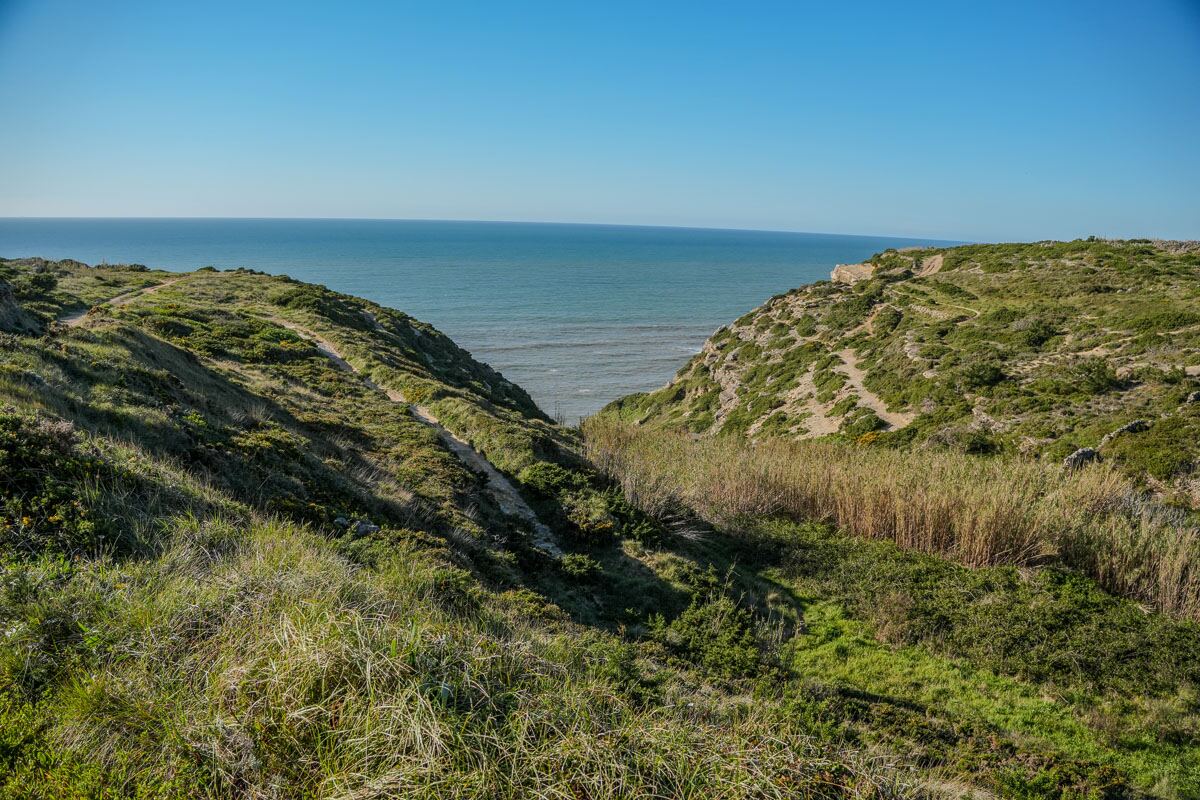
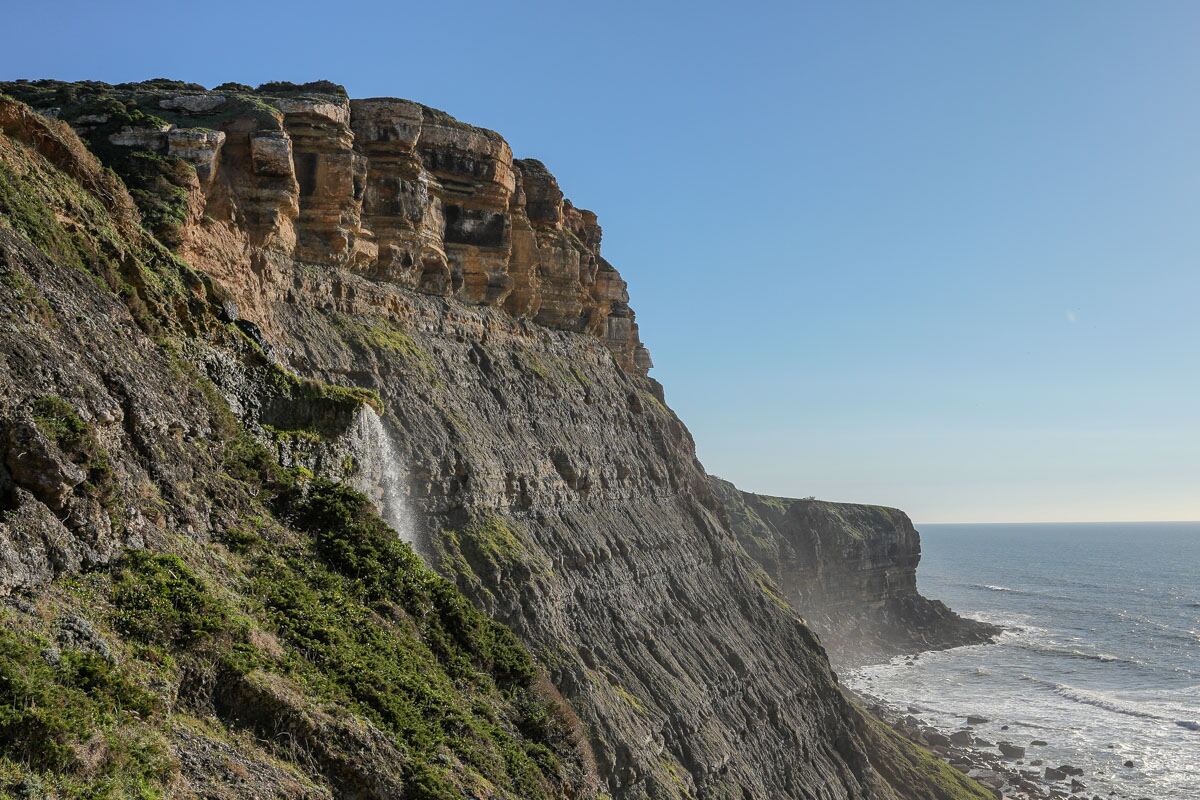
Sintra's coast is the wildest within reach of Lisbon: cliffs, cold water, hard afternoon wind and almost no development, because the natural park stops it. Six beaches in fifteen kilometres, all of them twenty minutes from the town over the hill, none of them warm. Lifeguards on the main ones from June to September. South to north:
- Praia da Adraga: tucked under high cliffs below Almoçageme, the prettiest of them, with one very good fish restaurant and a car park that fills by ten.
- Praia Grande: the long flat one, the surf schools, a sea-water pool at the south end and the most reliable parking.
- Praia das Maçãs: the family beach, with a river mouth, the shops of a small resort and a tram down from Colares in summer.
- Azenhas do Mar: barely a beach, a village stacked on a cliff over a tidal pool, and the photograph everybody takes.
- Praia do Magoito and Praia de São Julião: further north, wider, quieter, and where the locals go on a hot Sunday.
- Praia da Ursa: a steep scramble down below Cabo da Roca, no facilities, no lifeguard, and the most spectacular sand on the coast.
Surf
A serious, cold, exposed coast that takes the same Atlantic swell as Ericeira an hour north, without the reefs and without the crowd. Praia Grande is the centre of it: a long beach break that holds a bigger swell than it looks, with schools on the sand and a wave for every level depending on the day. Praia das Maçãs is gentler and better for a first lesson, and Adraga picks up more size and more rip than beginners should be in. The summer north wind blows onshore most afternoons, so mornings are the surfable hours; autumn and winter bring the size with cleaner conditions and water around fifteen degrees.
- Surf At Surf School: federation-certified, teaching at Praia Grande and Praia das Maçãs, all levels.
The parks and palaces
This is what the place is, and as a resident you experience it completely differently from a visitor. The Pena palace, the Moorish castle, Monserrate, the Capuchos convent and Cabo da Roca are all run by one body, and anyone resident in Portugal gets in free on Sundays and public holidays with an identity document. The annual pass costs €90, or €285 for a family, and pays for itself in about five visits. Monserrate's gardens on a wet Tuesday in January, with nobody else in them, is the single best argument for living here.
Quinta da Regaleira, with the initiation well, is privately run and ticketed separately, and is the one to take visitors to. Between them these estates give you several hundred hectares of walkable forest, which is not a bad substitute for a garden.
- Parques de Sintra: Pena, Monserrate, the Moorish castle, Capuchos and Cabo da Roca, free on Sundays for residents with ID.
- The annual pass: €90 for an adult or €285 for a family, worth it from about the fifth visit.
- Quinta da Regaleira: the initiation well and its gardens, privately run and ticketed separately.
Walking and cycling
The serra is laced with marked paths and this is the real reason to live here rather than in the town below. The circuit to the Peninha chapel is about six kilometres with the best view on the range; the Capuchos loop is five through the mossiest forest in Portugal; the Cabo da Roca route runs thirteen along the cliffs to the westernmost point of the continent; and the Colares wine trail covers fifteen and a half through the sand vineyards that make one of Portugal's oldest wines. All of them are walkable in winter, which very little else in Portugal is.
Cycling is harder work: the hill is steep, the roads are narrow and the coaches are unforgiving, so most riders head north through the villages towards Magoito rather than up. Mountain biking in the serra is good and there is a lot of it.
- The marked trails: the council's route pages: Peninha at 5,9 km, Capuchos 4,9, Cabo da Roca 13,2 and the Colares wine trail 15,5.
In town
Off the hill: the municipal market on a Saturday morning, the São Pedro fair twice a month, the concert hall at Olga Cadaval, and the queijada counters that have been open since the eighteen hundreds. The town runs a festival of music in the palaces each summer that is genuinely worth planning around, and the whole calendar of the place tilts towards visitors, which is either a service or an irritation depending on the week.
Visiting
36 hours in Sintra
In the manner of the New York Times column: arrive Friday afternoon, leave Sunday, and use the weekend to test the area before you decide. Every stop is chosen to answer a question a future resident has, not a visitor.
Come in winter if you are serious. The damp, the cloud on the hill and the four o'clock dark are what people misjudge here, and a June weekend shows you none of them. Failing that, come on a Sunday, when residents get into the parks free.
Friday
- 5.30 pm São Pedro, not the palaces. Park at São Pedro and walk down through the old streets to the centre as the last coaches leave. You get the same architecture, the tascas the town actually eats in, and a clear view of what the place is like when it belongs to the people who live in it.
- 8 pm Incomum. Dinner at the best kitchen in the town, mains €16 to €22, about €40 a head with wine. Book, and note that it is closed on Wednesdays.
- 10.30 pm Casa do Fauno. Out at Quinta dos Lobos, a real pub with folk sessions and its own mead, open until one. This is the whole of the town's nightlife, so judge it now.
Saturday
- 9 am Loja 5, in the market. Coffee at the only specialty bar for miles, inside the municipal market, with the produce stalls around you and the craft beer bar not yet open.
- 10.30 am Up to Peninha. Six kilometres through the forest to the chapel on the ridge, with the best view on the range: the coast one way, the Tagus the other. Two hours, and the clearest possible answer to whether you want to live in a wood.
- 1.30 pm Colares and the villages. Down the north side to Colares, Almoçageme and Banzão, which is where people who live here actually live. Lunch in a village room, then look at the houses, the distance to the school and how far you are from a shop.
- 3.30 pm Over to the coast. Twenty minutes to Praia Grande and then round to Adraga under its cliffs. Cold, wild, half empty and ten degrees windier than the village you just left. This is the compensation for the damp.
- 6.30 pm Bar do Fundo. The terrace at the far end of Praia Grande, facing straight west. Take a jumper, in any month.
- 8.30 pm Nortada. Fish by the kilo at the family house above the beach, going since 1979. About €50 a head, and the bill depends entirely on what you point at.
Sunday
- 10 am Monserrate, free if you live here. The gardens on a Sunday morning, which residents of Portugal enter free with an identity document. Walk the whole estate. This is the thing you would do most weeks, and the annual pass at €90 is the arithmetic to have in your head.
- 1 pm Azenhas do Mar. Lunch on the cliff beside the tidal pool in the village stacked above the sea, about €40. Then walk down to the pool and decide whether you would swim in it.
- 3.30 pm Linhó, or the train. If there are children, drive to Linhó and look at the two schools and the gated streets around them, then time the run to Cascais. If there are not, take the train from Sintra to Rossio and back, forty minutes each way, which is the commute this town is really offering. Then the A16 to the airport, half an hour.
Explore the surroundings
Sintra sits between a capital, a coast and a mountain, which is a rare address. Everything below is within an hour, and the first two you would see most weeks.
- Cascais: twenty-five minutes over the hill, the seaside town with the services, the sailing and the shopping this side lacks.
- Lisbon: forty minutes by train to Rossio, for the museums, the concerts, the work and the airport.
- Cabo da Roca: twenty minutes west, the westernmost point of continental Europe, and the cliff walks either side of it.
- Ericeira: forty minutes north, the surf reserve, a warmer town and better coffee.
- Mafra: half an hour north, the baroque palace and its walled hunting park, and a quarter of Sintra's crowds.
- Óbidos: an hour and a quarter north, the walled town and the lagoon, and the Silver Coast's prices.
Hotel recommendations
Two bases, and they answer different questions. Stay in the old town to understand what living beside the palaces is like, coaches and all; stay at Linhó if the school run is the thing you are really here to test.
- Lawrence's Hotel: sixteen rooms in the old town, a walk from the agents, the palaces and the restaurants.
- Penha Longa Resort: at Linhó, with golf and a spa, and the right base for viewing Beloura and both international schools.
Sources
Sold pricesexactmunicipalINE, Estatísticas de preços da habitação ao nível local, indicator 0012234: the median deed price per square metre of every home sold in the trailing twelve months, by municipality and parish, refreshed from INE's API each quarter. Deed prices, not asking prices.
IMI, tourist tax and containmentexactmunicipalIMI: Sintra council, 0,30% on urban property for 2026. Tourist tax €2 per person per night, up to 7 nights. No binding containment as of July 2026.
Figures calibrated 2026-08.